

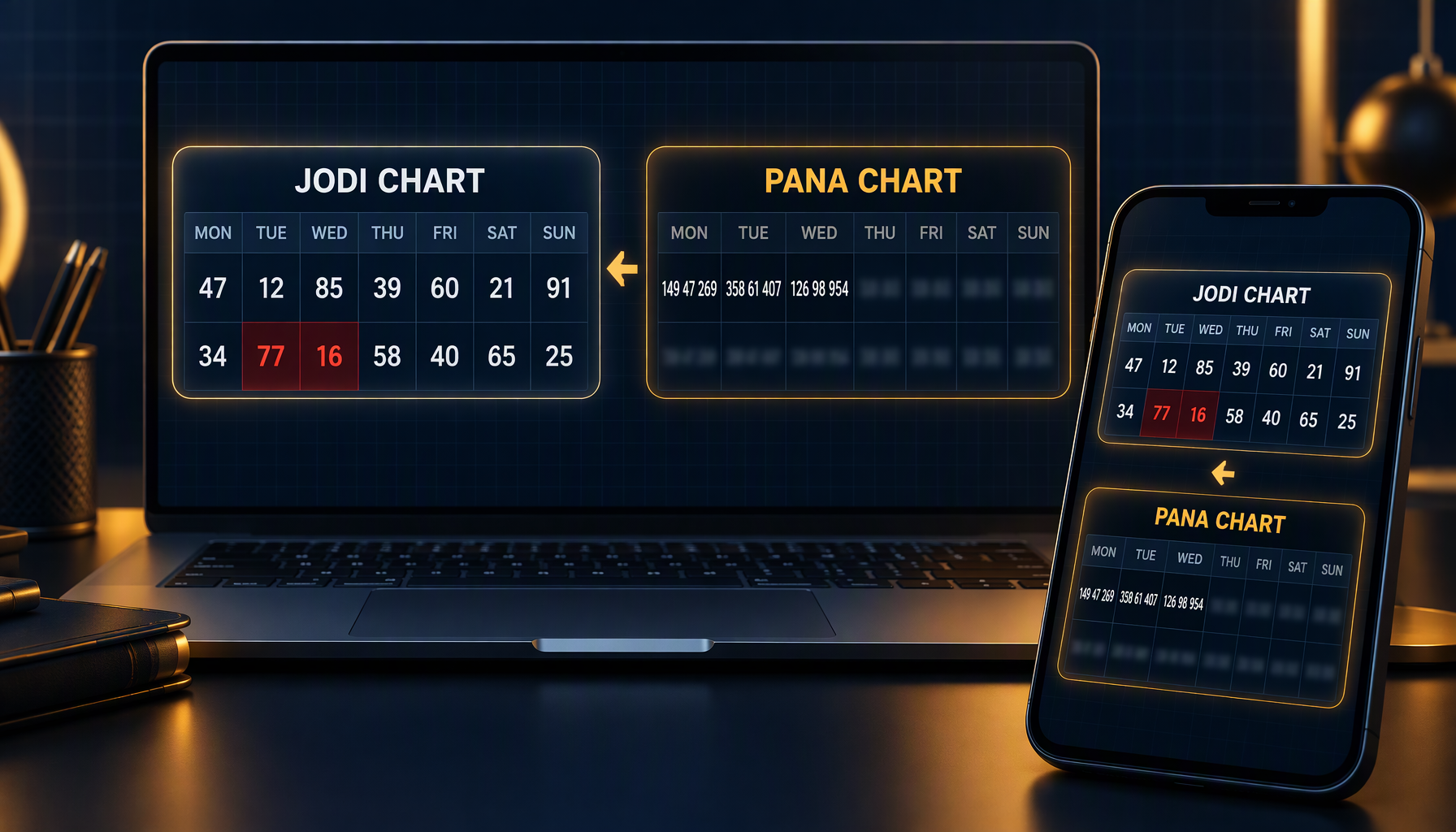
A Jodi chart and a Pana chart are not two different datasets — they are two different views of the same daily results. The Pana chart (also called a panel chart) shows the full eight-digit record for a day: the three-digit Open Pana, the two-digit Jodi, and the three-digit Close Pana. The Jodi chart shows only the middle two digits of that same record. Open the Jodi chart when your question is about the day's bracket; open the Pana chart when your question is about how that bracket was produced.
The One-Line Difference
Every declared Satta Matka session is stored as a three-part record, and the two charts differ only in how much of that record they display per cell:
- Jodi chart — one cell per day, containing the two-digit bracket formed by joining the Open single digit (Ank) and the Close single digit. For a Kalyan day declared as
149-47-269, the Jodi chart cell shows47. - Pana chart — one cell per day, containing all three parts of the same record in order: Open Pana
149, Jodi47, Close Pana269.
On Sara777 both views use an identical weekly grid: one row per calendar week running Monday through Sunday, with the date range printed in the leftmost column. Rows are ordered chronologically, so the newest week sits at the bottom of the archive. If you can read one layout, you can read the other immediately — the only variable is how many digits each cell carries.
What Each Chart Cell Actually Contains
The two-digit value in a Jodi chart is derived, not drawn. Each three-digit Pana produces a single digit by summing its digits and keeping the last one, and the Jodi is the pair of those two results, Open first:
| Chart | Digits per Cell | Stored in That Cell | Best Answered By |
|---|---|---|---|
| Jodi chart | 2 | Open Ank + Close Ank, joined in order | "What was today's bracket?" and bracket-level history |
| Pana chart | 8 (3 + 2 + 3) | Open Pana, Jodi, and Close Pana for the same day | "Which panels produced that bracket?" and session-level detail |
Working the example backwards makes the relationship concrete. Kalyan's Open Pana 149 sums to 14, giving Open Ank 4. The Close Pana 269 sums to 17, giving Close Ank 7. Joined in order they declare Jodi 47 — the exact value the Jodi chart prints for that date. The Pana chart prints the arithmetic as well as the outcome, which is why the two pages can never disagree with each other.
Same archive, two projections. Sara777 builds both pages from one set of verified daily records, so the Jodi view is a projection of the Pana view rather than a second source of truth. Compare them live on the Kalyan Jodi Chart and the Kalyan Pana Chart for the same market.
How the Two Charts Fill In During a Day
A market declares twice: once for the Open session and once for the Close. Because the two charts hold different amounts of the record, they also complete at different moments — a difference that confuses many first-time readers.
| Moment | Jodi Chart Cell | Pana Chart Cell |
|---|---|---|
| Before the Open session declares | ** |
*** ** *** |
| After Open declares, before Close | 4* — first digit live, second still pending |
149 4* *** — Open Pana and its Ank visible |
| After Close declares | 47 — final |
149 47 269 — final |
Two practical consequences follow. First, a Jodi chart stays incomplete for the entire gap between the two sessions, because the bracket is only definable once both single digits exist. Second, the Pana chart is the more informative view during a live session: it already shows the Open Pana and its derived digit while the Jodi view shows a half-filled pair. Our guide to what asterisk placeholders mean on charts covers the full state table, including off-days and historical gaps.
Red Highlighting Appears on Both Charts
Certain cells are printed in red on either view, and the rule is identical because it is evaluated on the same two digits. A Jodi is flagged when its two digits are equal (11, 77) or when they differ by exactly five (16, 27, 49, 60). On a Pana chart the red flag sits on the whole three-part cell, since the bracket is one of its components; on a Jodi chart it is the only thing on screen, so the pattern reads faster there.
Nothing about the flag changes the underlying record — it marks an arithmetic property of the declared digits, nothing more. Markets with a longer archive make the pattern easier to spot; the Kalyan record is worked through in our Kalyan Jodi Chart explainer.
Which Chart Answers Which Question
The fastest way to choose is to match the chart to the question you actually came to answer:
| Your Question | Open This Chart | Why |
|---|---|---|
| What bracket did this market declare today? | Jodi | One two-digit value per day, no parsing needed |
| What was the full result — panels included? | Pana | The Jodi chart has discarded both panels by design |
| Was today's Open a single, double, or triple panna? | Pana | Panel classification is only visible in the three-digit value |
| Scan several months of brackets quickly | Jodi | Four fewer digits per cell means far more dates on screen |
| Check that a published digit is arithmetically consistent | Pana | Both panels and the bracket are in one cell, so the sums are verifiable on the spot |
| Read today's result while the market is still running | Pana | Open-session detail appears hours before the bracket completes |
The Search Boxes Behave Differently — This Matters
Both chart pages carry a filter field above the table, but they look inside different parts of each cell. On the Jodi chart the search matches only the two-digit bracket, so entering 47 highlights every date that declared it. On the Pana chart the same field matches the Open Pana, the Jodi, and the Close Pana — which means a three-digit query such as 149 only ever returns hits on the Pana view.
This is the single most common reason readers conclude that "the search is broken": they type a panel number into the Jodi chart, where no panel is stored. Match the query length to the view — two digits for the Jodi chart, two or three for the Pana chart — and the highlights, plus the automatic scroll to the first matching cell, work on both.
Reading Order: A Practical Workflow That Works
Most readers move between the two views rather than choosing one permanently. A reliable sequence for any market:
- Locate the date on the Jodi chart. Two digits per cell makes it the fastest way to find where in the archive you are.
- Switch to the Pana chart for the same week. The layout is identical, so the cell you want is in the same row and column.
- Verify the bracket against both panels. Sum each three-digit panel, take the last digit of each sum, and confirm the pair matches the middle value. A record that fails this check is not an archive worth reading.
- Classify the panels if that is your interest. Distinct digits, one repeated pair, or all three identical — this classification exists only in the Pana view.
- Return to the Jodi chart for pattern-level scanning. It is the lighter page for covering many weeks.
What a Pana Chart Costs You in Screen Space
The trade-off for the extra detail is density. A Pana cell is roughly four times the width of a Jodi cell, so on a phone the panel archive scrolls horizontally sooner and shows fewer weeks without scrolling. On Sara777 both tables are inside horizontally scrollable containers on small screens, and each chart page carries a direct shortcut to its counterpart view for the same market — so switching costs one tap rather than a trip back through the charts directory.
Common Mistakes When Comparing the Two Charts
Treating them as independent sources
Because the pages have separate URLs, readers sometimes expect them to hold separate records and worry when one looks "behind". They are generated from the same archive, so any real difference between them would be a defect in the page, not a second opinion. Refresh both before drawing a conclusion.
Assuming the Jodi chart is missing data
A Jodi cell legitimately shows only two of the eight stored digits. That is a display decision, not a gap. If you want the panels, the Pana chart for the same market has them all along.
Carrying a pattern across markets
Charts are market-scoped. The Kalyan archives — Jodi and Pana — describe Kalyan's declared sessions only, and each market draws on its own fixed IST schedule. Comparing brackets across markets is possible; transferring expectations from one to another is not.
Frequently Asked Questions About Jodi and Pana Charts
Is a panel chart the same thing as a Pana chart?
Yes. "Panel", "Pana", and "Patti" refer to the same three-digit figure, and the two names for the chart are used interchangeably across the ecosystem. Sara777 labels the page a Pana chart and the underlying figure a panel in different places; both display the complete three-part record.
Which chart should a beginner learn first?
Start with the Pana chart, because it is the complete record — once you can read it, the Jodi chart is simply the middle of a line you already understand. The arithmetic itself is walked through step by step in our Jodi and panel chart guide.
Why does the Jodi chart show 4* instead of a number?
The market's Open session has declared and its single digit is known, but the Close session has not yet, so the second digit of the bracket does not exist. The cell completes when Close declares.
Do the two charts cover the same date range?
Yes. Both views render the same weekly rows from the same record set for a market, so their archives begin and end on the same dates. A date present in one is present in the other, with the same digits.
Can I use either chart to check yesterday's result?
Yes, and both views carry the same date. Use the Jodi chart if you only need the bracket, the Pana chart if you want the panels behind it as well. Every market page is organized into weekly rows, so a date you have already found in one view sits in the same row and column in the other.
Responsible Information Notice: Charts are archives of outcomes that have already been declared. Neither view reveals anything about future draws, and no reading order, pattern, or highlighted bracket changes how a session is drawn. Satta Matka carries real financial risk, is restricted or prohibited in several Indian states, and is for adults only — verify your local law and set strict limits before participating.