

If you have ever examined a Panel chart or a market rate card, you have encountered the standard figure of 220 Pattis. Every three-digit outcome recorded across open and close sessions belongs to this exact set. But where does the number 220 come from? It is not an arbitrary tradition or an informal convention—it is the exact mathematical count of all unique three-digit combinations that can be formed from ten digits when repetition is allowed and order does not matter.
The total of 220 is derived by dividing every possible three-digit combination into three mutually exclusive categories: 120 Single Pattis (three distinct digits), 90 Double Pattis (two identical digits and one different), and 10 Triple Pattis (all three digits identical). Adding these groups together produces the complete set: 120 + 90 + 10 = 220.
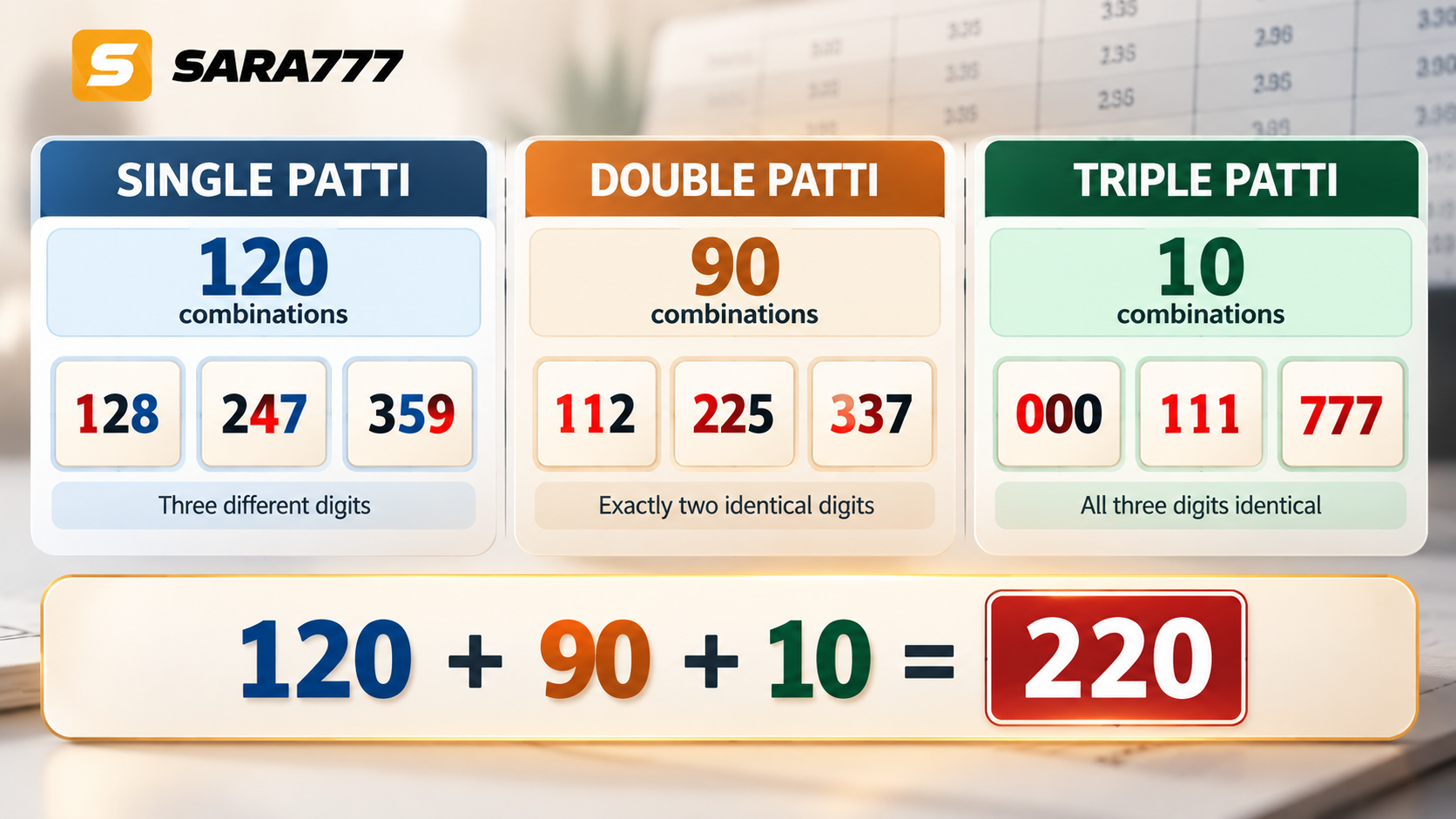
The three structural groups that partition all 220 unique three-digit Patti combinations on Sara777 records.
What Does a Patti Combination Mean?
In Satta Matka recordkeeping, a Patti (also called a Pana or Panel) is a three-digit value between 0 and 9 drawn to determine a session result. On verified archives like the Kalyan Panel Chart, these three digits are always written in ascending (non-decreasing) order.
Because digits are standardized into ascending order, different arrangements of the same three numbers are not counted as separate outcomes. For example, the digits 1, 2, and 8 can be written in six different orders (128, 182, 218, 281, 812, 821). In chart records, all six represent the same combination: 128.
This distinction between an ordered sequence (permutation) and an unordered selection (combination) is the foundation of the 220 figure. When order is ignored and duplicates are merged into a canonical ascending form, exactly 220 unique combinations exist across the digits 0 through 9.
Group 1: 120 Single Patti Combinations
A Single Patti (abbreviated as SP) is any combination where all three digits are completely different from one another. Examples include 128, 247, and 359.
To find how many Single Pattis can exist, we calculate how many ways we can choose three distinct digits from the ten available digits (0, 1, 2, 3, 4, 5, 6, 7, 8, 9) without repetition and without regard to order. This is the standard combination formula:
Single Patti Formula
C(10, 3) = (10 × 9 × 8) / (3 × 2 × 1) = 720 / 6 = 120
Selecting any 3 distinct digits out of 10 creates 120 unique unordered sets. Because each set is written in ascending order, there are exactly 120 Single Pattis.
Because each Single Patti can be arranged in 3! = 6 different ways, these 120 combinations account for 120 × 6 = 720 of the 1,000 possible three-digit numbers between 000 and 999.
Group 2: 90 Double Patti Combinations
A Double Patti (abbreviated as DP) occurs when exactly two digits are identical, and the third digit is different. Examples include 112, 225, and 337.
To derive the number of Double Pattis, we break the selection into two independent decisions:
- Choose the repeated digit: There are 10 possible digits (0 through 9) that can appear twice.
- Choose the distinct third digit: Once the repeated digit is chosen, the third digit must be chosen from the remaining 9 digits.
Double Patti Formula
10 choices for the pair × 9 choices for the single digit = 90
Multiplying the 10 possible pairs by the 9 possible remaining numbers yields exactly 90 Double Pattis.
For instance, if the repeated digit is 1, the possible Double Pattis are 110, 112, 113, 114, 115, 116, 117, 118, and 119 (9 combinations for digit 1). Repeating this across all 10 digits produces 90. Each Double Patti has 3 permutations (for example, 112, 121, 211), meaning these 90 combinations account for 90 × 3 = 270 three-digit numbers.
Group 3: 10 Triple Patti Combinations
A Triple Patti (abbreviated as TP) occurs when all three digits are identical. Because there are only 10 digits in our numerical system (0 through 9), there are exactly 10 possible Triple Pattis:
Because all three digits are identical, each Triple Patti has only 1 arrangement. These 10 combinations account for exactly 10 numbers in the 000–999 sequence. As explained in our guide to Matka rate lists and payout multipliers, their low occurrence rate is why Triple Pattis carry the highest payout ratio in the market.
Putting the Three Groups Together
Any combination of three digits must fall into one of these three categories: either all three digits are distinct, two are the same, or all three are the same. No three-digit number can belong to more than one group, and no three-digit number can fall outside them.
| Patti Category | Digit Structure | Representative Examples | Combinations | Permutations (Out of 1,000) |
|---|---|---|---|---|
| Single Patti (SP) | Three distinct digits | 128, 247, 359 |
120 | 720 (72.0%) |
| Double Patti (DP) | Exactly two identical digits | 112, 225, 337 |
90 | 270 (27.0%) |
| Triple Patti (TP) | All three digits identical | 000, 111, 777 |
10 | 10 (1.0%) |
| Total Valid Patti Combinations | 220 | 1,000 (100.0%) | ||
This simple addition — 120 + 90 + 10 = 220 — is why the entire panel system across Indian Matka charts contains exactly 220 entries.
The Unified Formula: Combinations With Repetition
In combinatorics, this problem can also be solved in a single step using the formula for combinations with repetition (also known as "stars and bars" or multisets). When choosing r items from a set of n distinct types where repetition is allowed and order does not matter, the formula is:
Multichoose Formula
C(n + r - 1, r)
Here, we have n = 10 possible digits (0 through 9) and we are selecting r = 3 digits for each Patti:
C(10 + 3 - 1, 3) = C(12, 3) = (12 × 11 × 10) / (3 × 2 × 1) = 1,320 / 6 = 220
Both methods yield the exact same total. Whether you add the three categories separately (120 + 90 + 10) or calculate the multichoose formula directly (C(12, 3)), the mathematical count is unambiguously 220.
Why 220 Combinations Is Different From 1,000 Ordered Strings
A common source of confusion is comparing the 220 Patti count with the 1,000 possible numbers between 000 and 999. In standard arithmetic, three independent positions each accepting digits 0 through 9 produce 10 × 10 × 10 = 1,000 permutations.
The difference comes down to whether digit arrangement matters:
- Permutations (1,000 outcomes): Position matters.
128,182,218,281,812, and821are counted as six distinct results. - Combinations (220 outcomes): Order is disregarded. All six arrangements above collapse into a single ascending Patti: 128.
As explored in our detailed Satta Matka Jodi & Panel Chart Guide, because digits are sorted into ascending order prior to publication, the 1,000 possible three-digit draws condense cleanly into exactly 220 canonical Pattis.
How the 220 Pattis Connect to Single Digits (Ank)
In actual chart operations, each of the 220 Pattis produces a Single Ank (a single digit from 0 to 9) through modulo-10 addition. The three digits of the Patti are added together, and the unit digit (last digit) of the sum becomes the session Ank:
- Patti 128:
1 + 2 + 8 = 11→ Unit digit is 1. - Patti 225:
2 + 2 + 5 = 9→ Unit digit is 9. - Patti 777:
7 + 7 + 7 = 21→ Unit digit is 1.
Every digit from 0 through 9 is associated with exactly 22 Pattis (typically 12 Single Pattis, 9 Double Pattis, and 1 Triple Patti). Multiplying 22 Pattis per digit across all 10 digits again confirms the total: 22 × 10 = 220. To learn how these open and close single digits combine into two-character pairs without dropping zeros, read our explainer on why a Jodi like 07 must keep its leading zero.
What the 220 Count Does—and Does Not—Tell You
Understanding the derivation of the 220 count is useful for reading panel charts accurately, but it is equally important to understand what this mathematical model does not imply:
- It does not mean all 220 Pattis have equal draw frequency: While there are 220 unique combinations, they do not have equal representation among the 1,000 possible permutations. Single Pattis represent 72% of all three-digit draws, Double Pattis represent 27%, and Triple Pattis represent only 1%.
- It does not predict future draws: In independent random draws, past appearances do not alter the likelihood of future outcomes. A Patti that has not appeared recently is not "due" to appear.
- It provides no mathematical shortcut or winning formula: The 220 count simply categorizes the complete outcome space. It is a tool for descriptive recordkeeping and chart interpretation, not predictive speculation.
Summary
The standard 220 Patti count on Sara777 and traditional Matka charts is the direct result of elementary combinatorics. By grouping unordered three-digit combinations into three distinct categories based on digit equality:
- 120 Single Pattis (all three digits different)
- 90 Double Pattis (two identical digits, one different)
- 10 Triple Pattis (all three digits identical)
These categories sum precisely to 220, perfectly matching the multichoose formula C(12, 3) = 220. When you review any session panel on Sara777, you are viewing an entry drawn from this mathematically complete 220-combination catalog.