

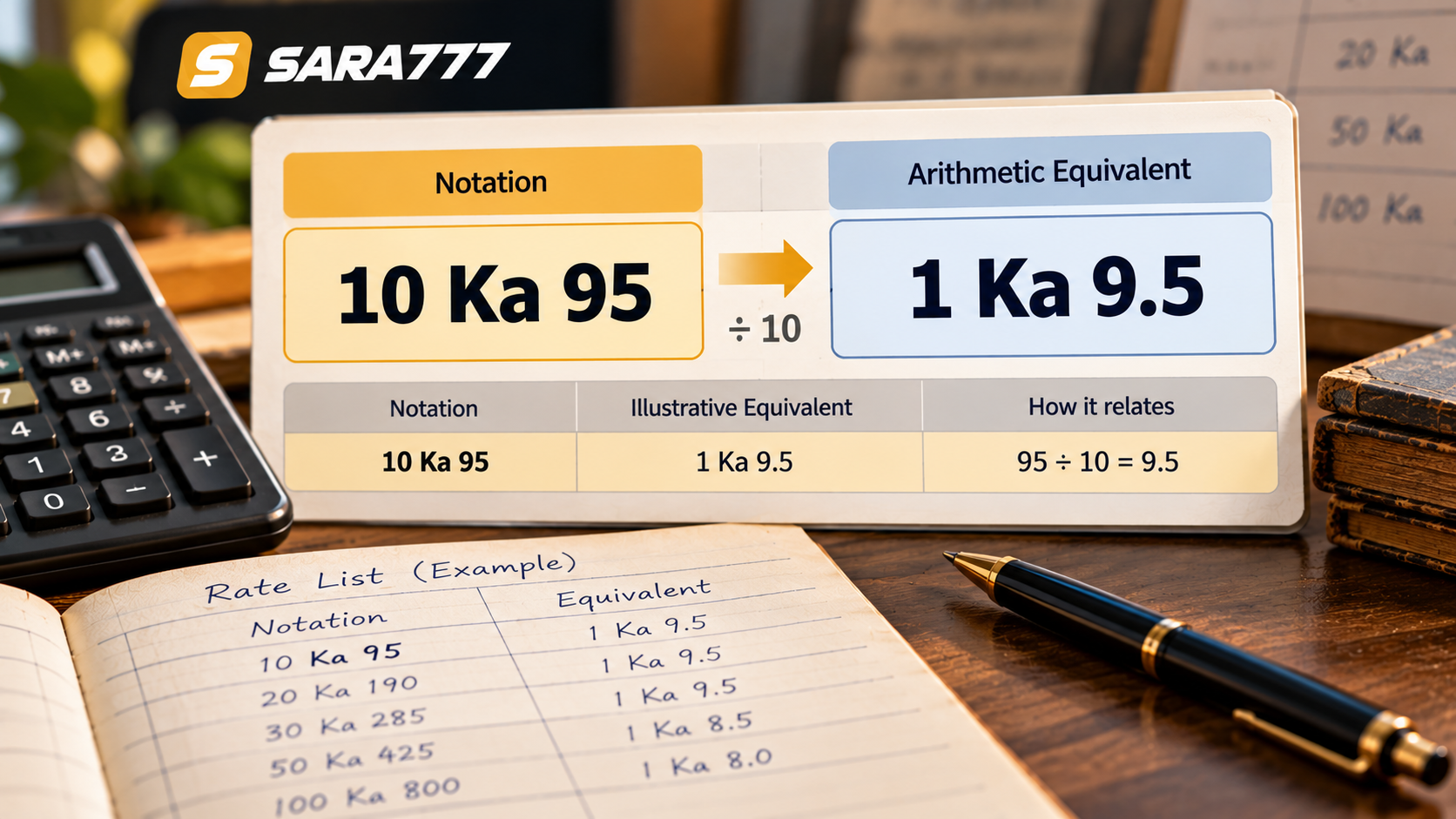
When looking at an informal Matka rate board or an online payout table, the phrase “10 Ka 95” frequently appears beside single-digit games. For anyone unfamiliar with South Asian wagering shorthand, the expression can look like an equation, a discount, or an obscure code. In reality, it represents a straightforward payout ratio: for every 10 units staked on a winning single digit, the advertised return is 95 units.
Linguistically, the Hindi preposition ka (का) denotes an exchange relationship or proportion—literally translating to “for 10, [receive] 95.” While the arithmetic is direct, reading rate tables accurately requires understanding how this notation operates, how it converts into modern decimal multipliers, and why gross payout must never be confused with net profit.
What the Two Numbers Represent
A rate quotation structured as [Stake] Ka [Return] divides an exchange into two distinct parts:
- The Base Unit (First Number — 10): The baseline stake committed to the wager. In traditional cash bazaars, this number represented 10 Indian Rupees (₹10).
- The Quoted Payout (Second Number — 95): The total amount credited or returned to the participant if the selected outcome matches the draw.
Why did market operators settle on 10 as the baseline instead of quoting a single unit? The practice originates from offline bazaar accounting. In physical booking stalls, wagers were exchanged in physical rupee denominations, commonly ₹10, ₹20, ₹50, or ₹100 notes.
Quoting a unit rate of 9.5 on a single rupee would have required bookmakers to handle 50-paise coins or fractional entries in manual ledgers. Quoting the table in tens kept the ledger figures in round, whole numbers across standard ticket values:
| Stake (Rupees) | Rate Formulation | Advertised Gross Payout |
|---|---|---|
| ₹10 | 10 Ka 95 (Base Unit) | ₹95 |
| ₹20 | 2 × 95 | ₹190 |
| ₹50 | 5 × 95 | ₹475 |
| ₹100 | 10 × 95 | ₹950 |
How “10 Ka 95” Relates to “1 Ka 9.5”
Mathematically, “10 Ka 95” and “1 Ka 9.5” describe the exact same underlying ratio:
95 ÷ 10 = 9.5
Dividing the advertised return by the base stake yields a standard unit multiplier of 9.5x.
While the mathematics are identical, the two phrases reflect different eras of gaming infrastructure:
- Traditional Chalkboards and Slips (“10 Ka 95”): Offline bookmakers operated primarily in cash notes and preferred integers that avoided decimal notation.
- Digital Apps and Online Dashboards (“1 Ka 9.5”): Modern web applications and mobile software compute fractional balances instantly. Displaying a base rate of “1 Ka 9.5” (or “9.5x”) allows players to enter micro-stakes (such as ₹1 or ₹5) without manual calculations.
Seeing “1 Ka 9.5” on a digital platform is simply the normalized, per-rupee expression of the classic “10 Ka 95” market rate.
Payout, Return and Profit Are Not Always the Same
A frequent source of confusion among beginners is whether the 95 units represents net profit or total return. In standard Matka terminology, rate listings quote the gross payout, not profit.
To understand the distinction, consider the three components of a winning transaction:
- The Initial Stake: The ₹10 committed to obtain the entry slip.
- The Gross Payout: The ₹95 handed back when the winning number is verified.
- The Net Profit: The gross payout minus the initial stake (₹95 − ₹10 = ₹85).
In conventional bookmaking practices, the original stake is not returned in addition to the quoted payout. The player receives ₹95 in total, yielding a net gain of ₹85. The original ₹10 is retained as part of the total settlement.
This differs from certain Western fixed-odds sports betting systems that list fractional odds (e.g., 8.5/1), where the original stake is explicitly refunded on top of the profit. In Matka rate lists, unless a specific operator clearly states otherwise, the printed number is always the total gross payment.
Why the Rate List's Context Matters
The phrase “10 Ka 95” is not a universal rate across all types of Matka games. It applies exclusively to Single Digit bets (often referred to as Ank, Single, or Open/Close Digit).
Because single-digit wagers involve picking one number from a set of ten (0 through 9), the mathematical probability of a random hit is 1 in 10 (10%). A mathematically fair game with zero commission would pay exactly 10-to-1 (i.e., “10 Ka 100”). The difference between 100 and the quoted 95 represents the operator’s commission, or house advantage (5%).
Other game formats feature completely different odds and correspondingly different rate scales. The table below compares the standard market payout spectrum, from basic single-digit predictions to complex multi-digit combination wagers:
| Game Type | Selection Format | Traditional Notation (10-Base) | Modern Unit Rate (1-Base) | Illustrative Return on ₹10 |
|---|---|---|---|---|
| Single Ank (Single Digit) | 1 digit from 0 to 9 (Open or Close) | 10 Ka 95 | 1 Ka 9.5 (9.5x) | ₹95 |
| Jodi (Bracket / Pair) | 2 digits from 00 to 99 (Open Ank + Close Ank) | 10 Ka 950 | 1 Ka 95 (95x) | ₹950 |
| Single Panna (Single Patti) | 3 distinct ascending digits (e.g., 128, 345) | 10 Ka 1400 – 10 Ka 1600 | 1 Ka 140 – 1 Ka 160 (140x–160x) | ₹1,400 – ₹1,600 |
| Double Panna (Double Patti) | 3 ascending digits with one duplicate pair (e.g., 112, 338) | 10 Ka 2800 – 10 Ka 3200 | 1 Ka 280 – 1 Ka 320 (280x–320x) | ₹2,800 – ₹3,200 |
| Triple Panna (Triple Patti / Motor) | 3 identical digits (e.g., 000, 111, 777, 999) | 10 Ka 7000 – 10 Ka 9000 | 1 Ka 700 – 1 Ka 900 (700x–900x) | ₹7,000 – ₹9,000 |
| Half Sangam | Open Panna + Close Ank, OR Open Ank + Close Panna | 10 Ka 10,000 – 10 Ka 14,000 | 1 Ka 1,000 – 1 Ka 1,400 (1,000x–1,400x) | ₹10,000 – ₹14,000 |
| Full Sangam | Complete combination of Open Panna (3 digits) + Close Panna (3 digits) | 10 Ka 1,00,000 – 10 Ka 1,20,000 | 1 Ka 10,000 – 1 Ka 12,000 (10,000x–12,000x) | ₹1,00,000 – ₹1,20,000 |
As the comparison shows, payout rates increase strictly in proportion to combinatorial rarity. A Single Ank requires matching one of ten digits (10% probability), whereas a Full Sangam requires matching two specific three-digit combinations simultaneously. For specific breakdown schedules on specialized formats, explore our Starline Matka guide and our Jackpot Matka full rate breakdown.
Assuming that “10 Ka 95” applies to a Jodi or Pana wager is a severe misunderstanding of how rate tables work. Each game type on a rate card possesses its own specific payout tier reflecting its combinatorial difficulty.
What the Notation Does Not Tell You
While rate tables display numerical ratios clearly, readers must recognize the limitations of what a rate list actually communicates:
- It Does Not Indicate Winning Probability: A high payout number reflects mathematical rarity, not an increased likelihood of success. The probability is dictated strictly by the number of possible outcomes in the draw.
- It Does Not Guarantee Settlement: A quotation printed on a website, forum, or chart banner is simply an advertised schedule. It carries no legal guarantee of operator liquidity, prompt settlement, or operational integrity.
- Rates Differ Across Platforms: While “10 Ka 95” is standard in many traditional markets, some regional bookies quote “10 Ka 90” (a 10% operator cut), while others quote “10 Ka 92”. Always verify the specific schedule of the platform being observed.
- It Has No Predictive Value: Payout multipliers describe financial exchange terms, not future outcomes. Understanding that 10 yields 95 provides zero statistical insight into which digit will be drawn next. Historical chart archives, such as those cataloged in our Charts Directory or explained in our Jodi and Panel Chart Guide, record past numbers for verification, but past draws do not influence future probability.
Summary
When you encounter “10 Ka 95” on a Matka rate list:
- The 10 is the base stake unit.
- The 95 is the advertised gross payout returned on a winning single digit.
- Dividing 95 by 10 yields 9.5, making it arithmetically identical to the modern notation “1 Ka 9.5”.
- The ₹95 figure is gross return, meaning net profit on a ₹10 ticket is ₹85.
- The notation applies specifically to single-digit plays (0–9) and does not apply to Jodi or Pana combinations.
To understand how numbers and historical sessions evolved from commercial commodities into the modern multi-tier structure, read our historical analysis on how Matka moved from cotton rates to number draws, or explore the meaning of chart markers in our guide on what asterisks mean on Matka records. For a broader overview of editorial guides and platform updates, visit the Sara777 Blog Hub.