

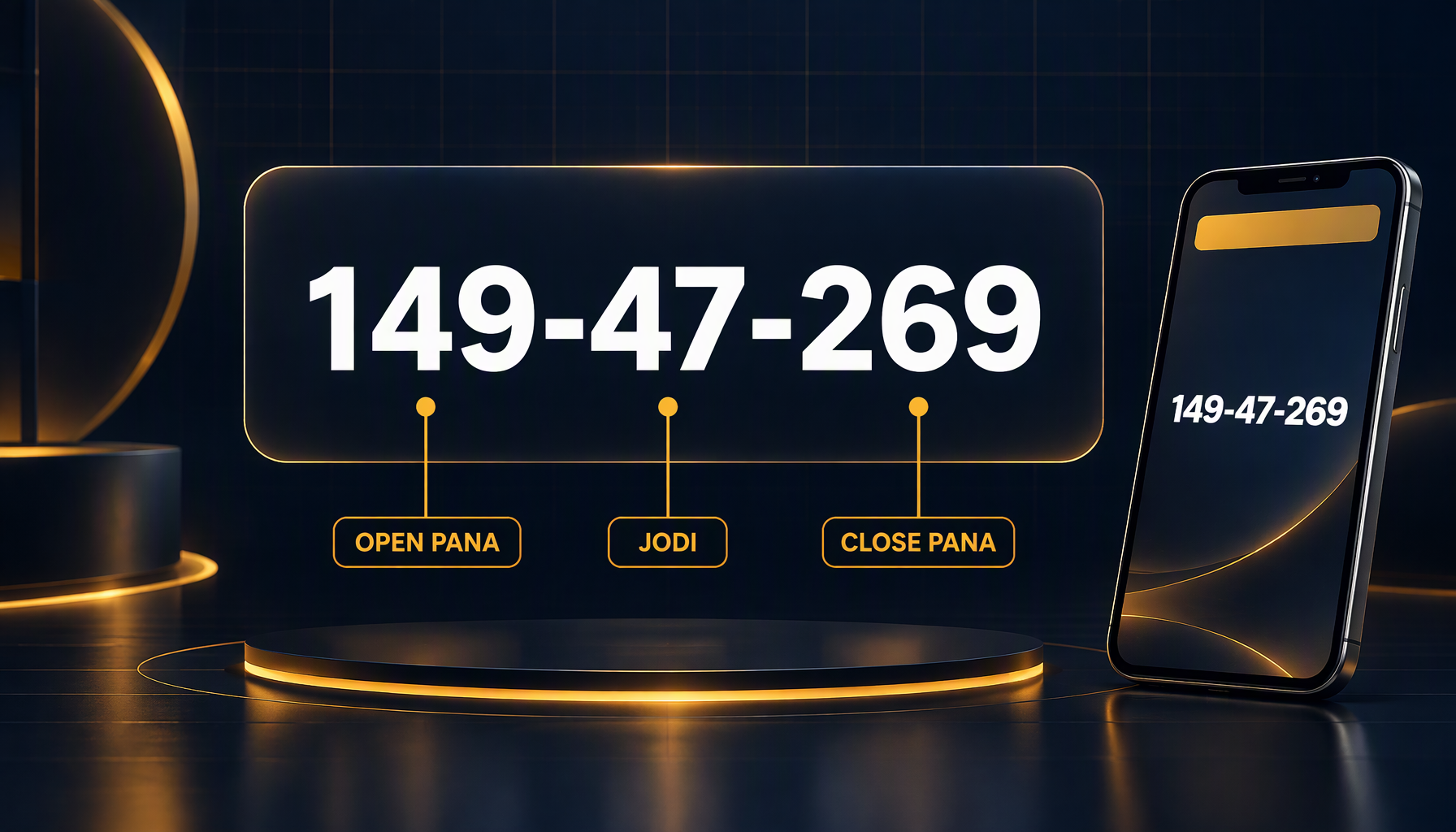
A declared Satta Matka result is one line of eight digits split into three parts — Open Pana, Jodi, Close Pana — and it is read left to right in a fixed order: take the first three digits, add them and keep the last digit of the sum to get the Open Ank, do the same with the last three digits for the Close Ank, join those two Ank digits to confirm the Jodi in the middle, then compare your own bet against the specific part of the line its format is supposed to match. This tutorial walks through all six steps using one real result line, 149-47-269, from start to finish.
Before You Start: What the Line Represents
One line describes one market on one date, covering both of that day's sessions. The three parts are not three separate numbers — the middle one is produced by the other two. If you have not seen the anatomy before, read the beginner's guide to what Satta Matka is first; everything below assumes you can tell a Pana from an Ank from a Jodi by name.
You also need the right market and the right date. A result line is meaningless without both: Kalyan and Milan Night can and do declare identical-looking lines on the same day, and each market keeps its own independent record.
Step 1: Confirm the Market and the Date Stamp
Start by fixing three things on the page you are reading:
- The market name. The record belongs to that market only. Nothing carries over between markets.
- The date the record is filed under. Archives are keyed by market date, which the platform derives from the market's own schedule rather than from the moment you happen to open the page. Trust the date printed on the record, not your memory of what day it is.
- The session times. Every chart and market page prints its Open and Close declaration times in Indian Standard Time (IST, UTC+05:30). Kalyan declares around 04:10 PM and 06:10 PM; Time Bazar around 01:00 PM and 02:00 PM. If you are reading from another time zone, convert before judging whether a result is late.
A status label next to the market tells you where in the day you are: Running for open means neither session has declared, Running for close means the Open session is done and the Close is pending, and Closed for Today means the day's schedule has finished.
Step 2: Read the Open Pana
The first three digits are the Open Pana — the three single-digit cards drawn in the opening session. In 149-47-269 the Open Pana is 149.
Two things to notice at this point. First, the digits are read position by position, in the order printed. A Pana of 149 and a Pana of 194 are different records, and a bet placed on one does not settle on the other. Second, the shape of the Pana tells you its class: three distinct digits is a Single Pana, one repeated pair is a Double Pana, and three identical digits is a Triple Pana. 149 is a Single Pana.
Step 3: Derive the Open Ank
The Open Ank is not printed separately — it is calculated from the Open Pana. Add the three digits and keep only the last digit of the sum:
- Open Pana
149→1 + 4 + 9 = 14→ Open Ank4.
Keeping the last digit is the whole rule, and it is why the Ank is always a single digit 0–9. A Pana of 999 sums to 27 and produces Ank 7; a Pana of 208 sums to 10 and produces Ank 0. Sums of 20 or more are common, so never assume the sum is the Ank — take the unit digit.
Step 4: Read the Close Pana and Derive the Close Ank
The last three digits of the line are the Close Pana, and the Close Ank comes out of it the same way:
- Close Pana
269→2 + 6 + 9 = 17→ Close Ank7.
The Close session is a separate draw several hours after the Open one, which is why a result line for a market that has only opened so far shows the Close half empty. Do not read a pending Close Pana as a zero — an absent session is displayed with placeholders, not with digits.
Step 5: Join the Two Ank Digits to Form the Jodi
The middle two digits of the line are the Jodi, and they are the Open Ank followed by the Close Ank — in that order, always:
- Open Ank
4+ Close Ank7→ Jodi47.
This is the step that confirms you have read the line correctly. If the Jodi printed in the middle of the record does not equal your two derived digits joined in that order, one of your sums is wrong — rework Step 3 or Step 4 rather than trusting the arithmetic you just did. It is also the step that explains why a Jodi cannot exist before the Close session declares: half of it is not knowable yet.
Self-check: a correctly read line satisfies one equation — the middle two digits equal the unit digit of the first Pana's sum, followed by the unit digit of the last Pana's sum. If 149-47-269 fails that test for any record you are reading, the record or the source is wrong.
Step 6: Check Your Bet Against the Correct Part of the Line
This is where most reading errors actually happen: players compare their number against the wrong segment. Each format has exactly one place in the line it is judged against, and for session-based formats you must also be looking at the right session:
| Format you hold | Part of the line it is judged against | Winning value in 149-47-269 |
|---|---|---|
| Single / Ank (Open) | The digit derived from the Open Pana | 4 |
| Single / Ank (Close) | The digit derived from the Close Pana | 7 |
| Jodi | The middle two digits, Open Ank then Close Ank | 47 |
| Open Pana (Single / Double / Triple) | The first three digits, in the printed order | 149 |
| Close Pana (Single / Double / Triple) | The last three digits, in the printed order | 269 |
| Half Sangam (A) | Open Ank plus Close Pana — both must land | 4 and 269 |
| Half Sangam (B) | Open Pana plus Close Ank — both must land | 149 and 7 |
| Full Sangam | Both Panas, exact and in order | 149 and 269 |
Note what this table implies for Sangam bets: they are the only formats that can be judged from a single glance at a complete line, because they are the only ones that consume both sessions at once. A Sangam ticket cannot be evaluated at all until the Close session declares — no partial reading exists. The bet formats themselves are described in the how-to-play guide.
How to Tell Whether the Day Is Actually Complete
A line is only readable in this sequence once both sessions exist. During the day you will see it in one of two unfinished forms:
149-4*-***— the Open session has declared. Steps 2 and 3 work; Steps 4, 5 and 6 do not, because the Close half does not exist yet.*** ** ***— nothing has declared for this date. Either the session time has not arrived, the market does not operate that day, or the record predates the archive.
Declarations also take a short certification window after the scheduled time — normally five to fifteen minutes — so a line that is still unfinished a few minutes past the posted Close time is not evidence of anything except latency. The full placeholder vocabulary, including permanent gaps and off-days, is covered in what *** ** *** means on charts.
Reading Mistakes That Change the Answer
Applying the Close Ank to an Open-session bet
Single-digit bets belong to one session. In our example line, holding 7 wins a Close Single and loses an Open Single, even though 7 appears in the same record. Identify your session before you look for your digit.
Reordering Pana digits
Panas are matched position by position. Readers often assume any arrangement of the same three digits counts as a hit; it does not, and a Pana bet on 149 against a declared 194 is a loss.
Reading the Jodi as a drawn number
Nobody draws 47. It is derived from two draws, which is why it is the last part of the record to become known and the first part to become unbettable — the platform closes Jodi betting for the day the moment the Open session declares. Session locks are explained in the rules guide for new players.
Treating a re-declared number as a correction
A session's result is stored once and cannot be declared again, and a Close result cannot be entered before its Open result exists. If a number you saw earlier differs from the archive now, the earlier one was not an official declaration — check the page for the market rather than a screenshot or a forwarded message.
Where the Same Line Appears in Two Different Views
The eight-digit record is shown in full on a market's Pana chart — for example the Kalyan Pana Chart — and reduced to its middle two digits on that market's Jodi chart. Both are the same archive rendered at different detail levels, so a line that fails the Step 5 self-check on one view will fail identically on the other. Choose the Pana view whenever you are working through these steps for the first time, because it is the only one that shows you the raw material the other steps consume.
Frequently Asked Questions About Reading Matka Results
How many digits is a Satta Matka result?
Eight, in three groups: three for the Open Pana, two for the Jodi, three for the Close Pana. Only six of those eight are actually drawn — the two Jodi digits are derived from the two Panas.
What if the sum of a Pana's digits is a single digit?
Then that sum is the Ank unchanged. 123 sums to 6, so its Ank is 6. The rule is always "keep the last digit", which covers both the single-digit and the two-digit sum cases without exception.
Can a result line change after I have read it?
No. Once declared and certified, a session's outcome is written to the archive permanently, and the system refuses a second declaration for a session that already has one. Any "corrected" number appearing later is a different source, not a revision.
Why does my Jodi look right but the record disagrees?
Almost always a reversed pair: 47 and 74 are different Jodis, because the first digit must come from the Open session and the second from the Close. Recheck which session each of your two Ank digits came from.
Do I read a Starline or Jackpot result the same way?
The same principle applies — derive each slot or session's single digit from its own panna — but those games declare across multiple slots rather than one Open and one Close, so the line has more parts and each part maps to a named slot instead of a single session.
Responsible Information Notice: This tutorial explains how to interpret outcomes that have already been declared. Nothing in a result line — no digit, sum, or pattern across past lines — carries information about a future draw, and reading records accurately does not improve odds. Satta Matka involves real financial risk, is restricted or prohibited in several Indian states, and is for adults only. Verify your local laws, set a fixed limit, and never treat Matka as a source of income.