

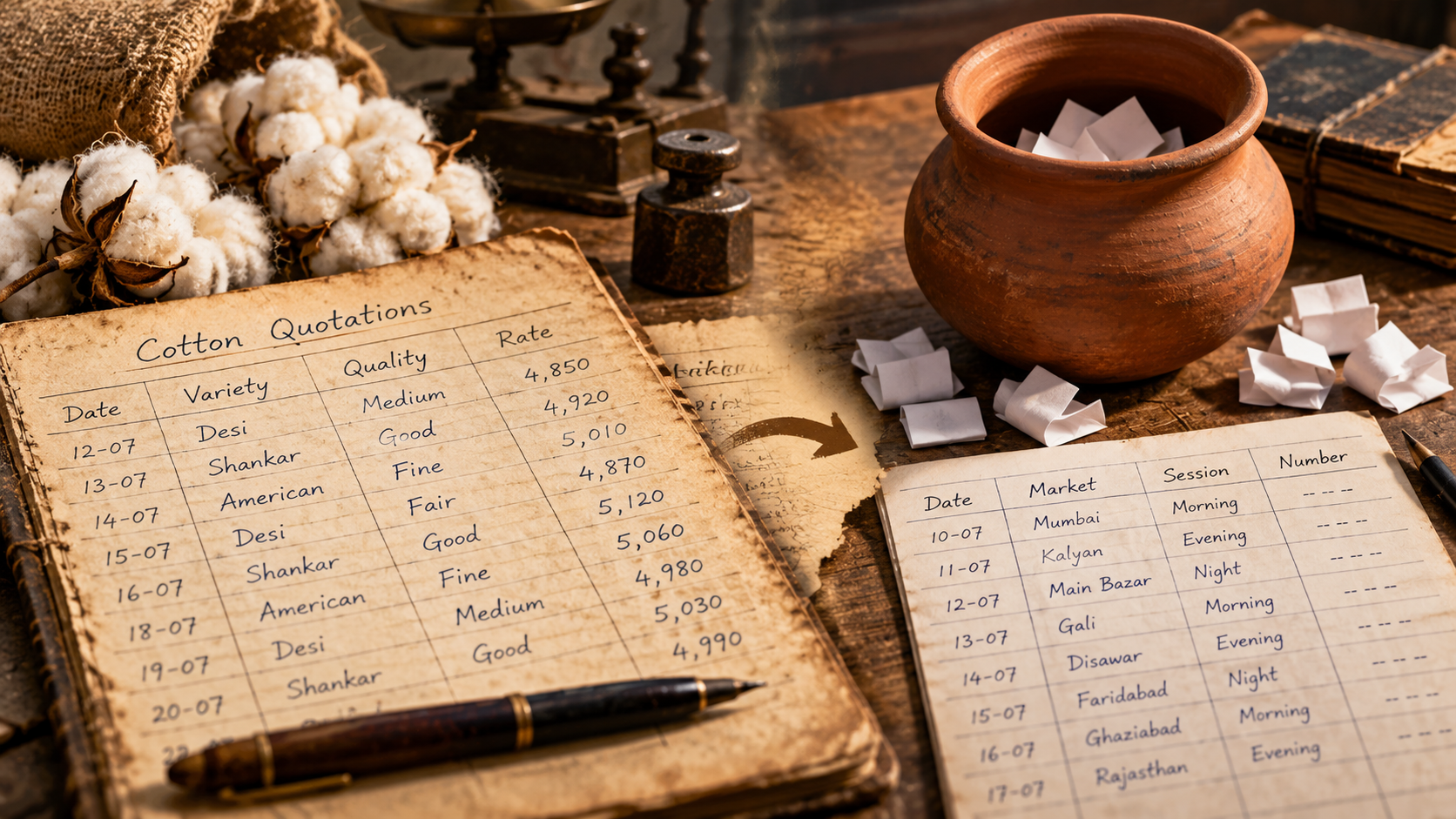
Before Satta Matka was associated with three-digit cards, weekly matrix charts, or synchronized evening draw schedules, it was not an internal lottery at all. In the 1950s, the practice revolved entirely around external commodity prices: punters gathered around trading bazaars in Bombay to wager on the opening and closing quotations of commercial cotton transmitted across telegraphic wires. Understanding how that arrangement collapsed and what replaced it explains why modern charts still use the vocabulary of financial exchanges.
Before the Number Draws: Cotton-Rate Quotations
In the decade following India's independence, Bombay was the undisputed capital of the nation's textile and trading economy. Central neighborhoods like Kalbadevi, Sewri, and Zaveri Bazaar bustled with traders, mill hands, and commission agents whose livelihoods depended on the volatility of raw cotton.
During this era, trading desks at the Bombay Cotton Exchange monitored price movements originating from the New York Cotton Exchange (NYCE). Commercial quotations—specifically the opening rate and the closing settlement rate per bale—arrived daily in Bombay via teleprinters.
Informal wagering naturally formed around these figures, known colloquially as Ankada Jugar (wagering on figures). Rather than betting on whole commodities, participants placed small stakes on the final digits of the transmitted rates. The system possessed an essential characteristic:
- External Generation: The outcome was anchored to a real, distant commodity market governed by international supply, weather patterns, and global shipping. Local bookmakers had no mechanical control over the figures received on the wire.
- Binary Daily Rhythm: Because commercial exchanges operated on discrete trading sessions, the wagering day had two natural settlement markers: the Opening rate and the Closing rate.
Why the Old Arrangement Changed
Relying on an overseas commodity exchange made the local wagering economy vulnerable to decisions made thousands of miles away. In 1961, that vulnerability materialized: the New York Cotton Exchange permanently halted the transmission of the relevant daily price feeds.
While popular retellings often simplify this turning point into a single decree, contemporary historical reporting—including investigative retrospectives by The Indian Express and India Today—indicates a convergence of commercial and regulatory factors. State authorities had intensified crackdowns on the misuse of teleprinter circuits for speculative betting, while the commercial exchange modified its market dissemination protocols.
Whatever the precise regulatory combination, the practical consequence was immediate: the external benchmark vanished overnight. Bookmakers in Bombay were left with thousands of eager participants, active storefronts in the mill districts, but no source of figures to settle their slips.
From External Quotations to Number Draws
To keep the trade functioning, operators had to replace an external market ticker with an internally generated random process. This transition unfolded in stages throughout the early 1960s:
| Feature | Commodity System (Pre-1961) | Number-Draw System (Post-1962) |
|---|---|---|
| Source of Outcome | External telegraphic price tickers (NYCE) | Physical random selection (earthen pot or playing cards) |
| Operating Calendar | Restricted to official commodity trading days (5 days/week) | Autonomous; expanded to 6 or 7 days per week |
| Record Structure | Terminal digits of commodity prices | Structured three-digit cards (Pana) and two-digit brackets (Jodi) |
| Verification Method | Reading incoming teleprinter printouts | Public draws conducted before witnesses or passers-by |
The first major innovation was the physical earthen pot—the matka. Slips of paper inscribed with digits from 0 to 9 were deposited into a clay pitcher, thoroughly mixed, and drawn by a neutral bystander or child in front of onlookers. Although the pot itself was eventually phased out in favor of modified card decks, the object was so iconic that it lent its name permanently to the entire genre of numbers games.
Shortly afterward, operators introduced playing cards as a more compact and verifiable drawing device. By drawing three cards from a stripped deck, operators could produce three distinct single digits, calculate their sum, and determine both a three-card combination and a final single outcome.
What Changed in the Record Format?
The shift from price tickers to number draws fundamentally altered how outcomes were recorded and tabulated:
- The Development of the Jodi: In the old cotton system, wagers typically focused on individual digits. With self-managed number draws, operators formalized the pairing of two distinct draw sessions—the Open draw and the Close draw—into a single compound unit called the Jodi bracket.
-
The Birth of the Pana (Panel): Drawing three individual cards made it possible to treat the three numbers as an ordered triplet (such as
1-4-8). This created the Pana structure, giving participants multiple mathematical tiers of participation instead of a simple binary guess. - Weekly Matrix Grids: Rather than logging raw ticker tapes, bookmakers began organizing outcomes into standard tabular matrices: seven weekday columns across horizontal weekly rows. That layout remains the universal standard on modern interfaces, such as the Kalyan Jodi Chart.
The People and Period Associated With the Transition
Two distinct figures dominated the transformation of Bombay's wagering landscape during this transitional decade:
- Kalyanji Bhagat (Kalyanji Gala): A grocer from Kutch who migrated to Bombay and resided in the BDD chawls of Worli. In April 1962, Bhagat launched Worli Matka, establishing a drawing schedule that welcomed wagers as low as one rupee, making it immensely popular among Central Mumbai's textile mill workforce.
- Ratan Khatri: A migrant from Karachi following Partition who initially partnered with the Worli network before launching New Worli Matka (later known as Ratan Matka) from Zaveri Bazaar in 1964. Khatri earned widespread notoriety for conducting his draws publicly in South Mumbai, frequently inviting film personalities, cafe owners, or street onlookers to draw the winning cards.
Historical Context: Why Mill Districts Mattered
The rise of number-based Matka was inextricably tied to Mumbai's Girangaon ("Village of Mills"). Tens of thousands of workers living in chawls sought affordable recreational pastimes after long shifts. The daily draw schedule mirrored their shift timings, anchoring Matka deep within the working-class cultural fabric of 1960s Bombay.
What the Popular Story Leaves Uncertain
Because Matka operated outside formal legal frameworks, historical accounts rely on police memoirs, press archives, and oral histories. Consequently, several details carry genuine uncertainty:
- The Exact Trigger of the 1961 Interruption: Popular lore frequently attributes the shutdown entirely to an administrative fiat from New York. However, historical documentation suggests that telecommunications curbs by the Indian post and telegraph department and targeted police raids against telegraphic bookies were equally decisive in shutting down the flow.
- The Attribution of Cards vs. Pots: Different oral accounts disagree on whether Kalyanji Bhagat used playing cards from day one or transitioned to cards only after starting with earthen pots. Family accounts recorded by journalists indicate that card decks with 12 figures (including Queen and King as 11 and 12) were tested early, whereas other bazaar accounts place the earthen pitcher as the primary device during the initial 1962 launch.
- Deck Composition: Historical sources describe differing deck modifications between rival operators. While Worli Matka originally retained court cards as extended figures, Khatri's syndicate later pulled Jacks, Queens, and Kings entirely to maintain a strict single-digit base from 1 through 9 (with Ace representing 1).
What Changed—and What Remained
When Matka moved from cotton rates to number draws, the underlying engine was completely remade. A game once beholden to international agricultural markets and telegraph cables transformed into a self-contained arithmetic system governed by physical draws and probability.
Yet the language of commodity trading refused to die. Decades after teleprinters went silent, every market cataloged in the Sara777 Master Charts Directory still divides its daily cycle into an Open and a Close. What originally designated the morning bell and the evening gavel of a financial exchange survives today as the opening and closing draw phases of an enduring folk record.
Explore Historical Matka Record Systems
Learn how modern Jodi brackets and Pana calculations evolved from these early drawing systems.
Read the Jodi & Panel Chart Guide