

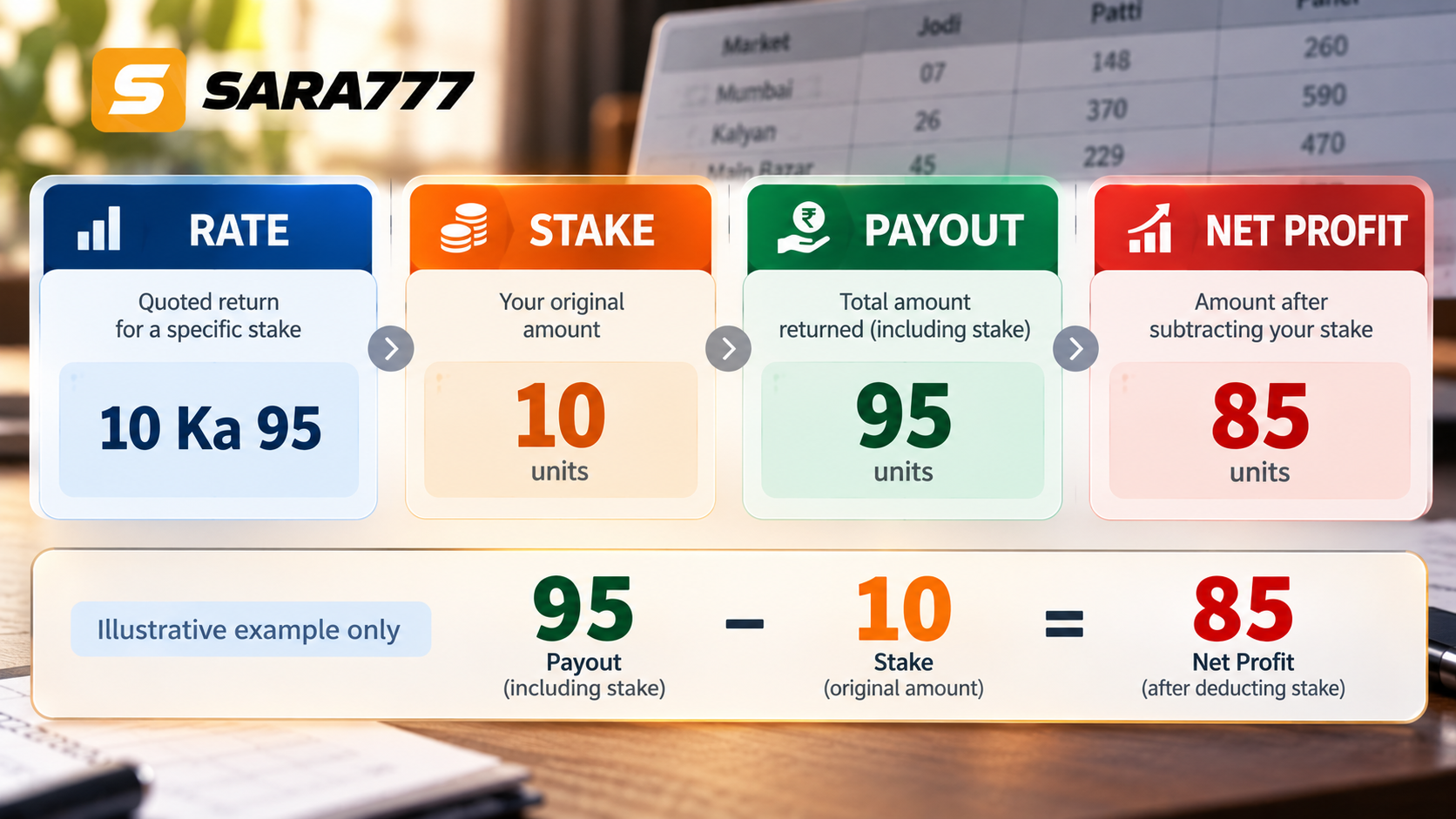
A Matka rate table typically presents an eye-catching figure—such as “10 Ka 95” or “9.5x”—beside a game format, but rarely clarifies how that figure connects to the money committed, the total amount returned, and the final profit or loss. Because informal listings use shorthand notation, readers frequently treat four distinct financial concepts as if they were interchangeable: rate, stake, payout, and net profit. Conflating these terms leads to distorted expectations about potential returns and obscures how settlement calculations actually work.
In gaming mathematics, clarity starts by separating the agreed ratio from the cash involved. A quoted number on a board is merely an exchange multiplier; it only produces a concrete financial outcome when tied to an entry amount under an explicit settlement rule. To evaluate any published listing accurately, one must examine each of these four terms individually and understand the different settlement conventions that govern them.
What Does “Rate” Mean?
In wagering terminology, a rate is the quoted exchange proportion established by an operator or listed on an informational schedule. It does not represent an absolute sum of money. Instead, it defines the contractual multiplier applied to an entry if the predicted outcome matches the official draw.
Across different gaming markets and publishing platforms, rates are expressed through several distinct conventions:
- Integer Base Ratio (e.g., “10 Ka 95”): The traditional Indian bazaar format, where the first number represents a benchmark stake unit and the second number represents the gross return returned on that unit.
- Normalized Decimal Multiplier (e.g., “9.5x” or “1 Ka 9.5”): Common on digital dashboards and mobile apps, where the multiplier is reduced to a per-single-unit basis so fractional stakes can be computed automatically.
- Fractional or Net Odds (e.g., “8.5 to 1”): Common in international bookmaking, where the quoted number reflects only the profit generated per unit staked, with the return of the stake understood separately.
Because different publishers adopt different formats, a reader cannot assume what a bare number signifies without checking the source's explanatory context. A listing that simply reads “Single: 95” could mean 95 times the unit stake, 95 units on a base of 10, or 95 units of gross return.
Stake: The Original Amount Committed
The stake is the exact monetary amount, account balance, or capital that a participant commits to a specific selection. It is the initial resource placed at risk.
Key characteristics that distinguish the stake from other figures include:
- Direct Risk Exposure: If the predicted draw does not occur, the stake is forfeited entirely. The quoted rate and potential payout become completely irrelevant once the outcome is lost.
- Scale Controller: While the rate defines the proportional relationship, the stake determines the physical magnitude of both the financial exposure and the resulting disbursement.
- Independent Variable: A player chooses their stake within the platform’s minimum and maximum ticket limits, whereas the rate is fixed by the market or operator schedule.
Rate cards often display multipliers prominently while placing minimum stake rules (such as ₹5, ₹10, or ₹100 per ticket) in small print or separate platform terms. Conflating the baseline stake listed in a notation (like the “10” in “10 Ka 95”) with the actual amount a user wagers is a frequent beginner mistake.
Payout: What Is Actually Being Returned?
The term payout (or total return) denotes the gross disbursement credited or handed to the participant if the chosen outcome occurs. It represents the total cash flow entering the participant's balance upon settlement.
The central point of confusion surrounding payouts is whether the quoted figure includes or excludes the original stake:
- Gross Payout (Stake Included): Under standard South Asian Matka conventions, the advertised payout is inclusive of the original stake. If an entry of 10 units yields a quoted payout of 95 units, the total sum transferred to the participant is 95 units. The original 10 units are not refunded on top of the 95.
- Net Payout Plus Stake Refund (Stake Excluded): In certain fixed-odds systems or casino table games, a “payout” quotation refers strictly to winnings, after which the house returns the original chips or wagered capital as an independent transaction.
Without knowing which convention a listing follows, a reader cannot determine whether a quoted payout represents total incoming cash or additional surplus.
Net Return Versus Net Profit
While everyday conversation frequently blends the words “return” and “profit,” rigorous accounting requires separating them:
| Metric | Formal Accounting Definition | Mathematical Formula | Illustrative Value (10 Unit Stake) |
|---|---|---|---|
| Initial Stake | Original capital committed to the selection | Outflow | 10 units |
| Gross Payout (Total Return) | Total money received upon a winning settlement | Inflow | 95 units |
| Net Profit (Net Gain) | Surplus remaining after subtracting the original stake | Gross Payout − Stake | 85 units (95 − 10) |
| Net Loss | Capital lost when the predicted outcome fails | 0 − Stake | −10 units (100% loss) |
The phrase “net return” is particularly susceptible to misinterpretation. In financial analysis, net return is often stated as a percentage yield or rate of return relative to capital invested (for example, an 850% net return on investment). In informal Matka discussions, however, people sometimes use “net return” loosely to refer to either gross cash received or net profit pocketed. To avoid mathematical errors, readers should avoid relying on the ambiguous term “return” and instead specify either gross payout or net profit.
One Example, Two Possible Conventions
To see why explicit definitions matter, consider a small hypothetical scenario using abstract units. Suppose a listing quotes a figure of “95” for a 10-unit entry. Depending on the settlement convention adopted by the operator or publisher, the arithmetic leads to two sharply different real-world results:
| Accounting Step | Convention A: Gross Payout Schedule (Standard Matka Rule) | Convention B: Net Profit Multiplier (Western Odds Rule) |
|---|---|---|
| Initial Stake | 10 units | 10 units |
| Quoted Figure (95) Defined As | Total gross payment returned to player | Net winnings above the original stake |
| Total Sum Disbursed | 95 units | 105 units (95 profit + 10 stake refund) |
| Net Profit Calculation | 95 − 10 = 85 units | 105 − 10 = 95 units |
| Effective Net Multiplier | 8.5x net gain | 9.5x net gain |
Notice that the final profit difference between the two interpretations is exactly 10 units—equivalent to 100% of the initial stake. In conventional Matka markets, Convention A is almost universally observed: the 95 units constitutes the total gross return, meaning net profit is 85 units. However, because rate cards rarely state “Convention A” explicitly on their banners, newcomers frequently assume Convention B and erroneously expect 105 units in total cash.
Why Two Rate Lists Can Describe the Same Figure Differently
Discrepancies in how rates are presented stem primarily from historical evolution and channel differences:
- Manual Slip Traditions: Physical bookmakers in neighborhood bazaars handled cash notes and handwritten ledgers. Quoting integer pairs like “10 Ka 95” avoided fractional coins and decimal columns on paper slips.
- Digital Normalization: Web applications and mobile portals calculate balances in software, allowing rates to be expressed as unit multipliers like “1 Ka 9.5” or “9.5x”. While mathematically identical to “10 Ka 95” (since 95 ÷ 10 = 9.5), the digital representation shifts the focus from a fixed 10-rupee note to variable micro-stakes.
- Aggregator Misquotations: Third-party chart portals and community forums often transcribe figures second-hand without verifying the underlying terms. One website may label 95 as “Payout Rate,” while another labels it “Winning Amount,” leaving readers to guess whether the stake is returned or retained.
For a detailed analysis of how the 10-base ratio translates to decimal scales across different single-digit and combination wagers, see our dedicated explainer on what 10 Ka 95 means on a Matka rate list.
What a Rate Table Does Not Tell You
Rate cards provide mathematical ratios under hypothetical winning conditions. They do not communicate the full reality of market participation. When reading any published schedule, recognize what the numbers omit:
- Winning Probability: A higher rate reflects mathematical difficulty, not favorable conditions. For example, a Jodi multiplier of 95x corresponds to a 1 in 100 combinatorial chance (1%), whereas a Single Ank multiplier of 9.5x corresponds to a 1 in 10 chance (10%). The rate simply mirrors combinatorial scarcity.
- Operator Commission (House Margin): In an unbiased single-digit lottery with ten outcomes, a mathematically fair return without an operator commission would pay exactly 10 to 1 (100 units on a 10-unit stake). A payout of 95 units embeds a 5% operator deduction. Rate lists display the final quotation without ever printing the built-in mathematical margin.
- Settlement Guarantees: A printed quotation on an informal website or chalkboard carries no statutory guarantee of solvency, prompt payment, or operational honesty.
- Payout Caps and Liability Restrictions: Most markets enforce maximum exposure caps on popular numbers or combinations (often called bracket limits). A rate list states the ratio but rarely displays the operator's total liability limits.
- Draw Pace and Capital Velocity: Fast-paced formats such as hourly Starline or Jackpot rounds may quote identical multipliers to traditional daily markets, but their high draw frequency significantly accelerates capital turnover and potential net loss. Readers can review how these structures contrast in our guide on how Starline and Jackpot result formats differ.
Four Terms to Keep Separate
To interpret any Matka listing or payout discussion with complete precision, keep these four operational definitions distinct:
| Term | Operational Role | Common Misconception |
|---|---|---|
| Rate | The quoted multiplier or ratio governing exchange | Assuming it represents guaranteed cash rather than an abstract ratio |
| Stake | The capital committed and placed at full risk | Confusing the base unit in a quotation (e.g., 10) with personal entry size |
| Payout | The total gross inflow returned upon a successful outcome | Assuming the original stake will be refunded separately on top of the payout |
| Net Profit | The true surplus remaining after deducting the initial stake | Treating total gross payout as pure profit |
Understanding these boundaries ensures that numerical figures on rate cards are evaluated as structured mathematical ratios rather than vague assurances. To verify multi-year historical draw sequences and market patterns, consult the Sara777 Charts Directory. For additional reference guides and platform tutorials, visit the central Sara777 Blog Hub.