

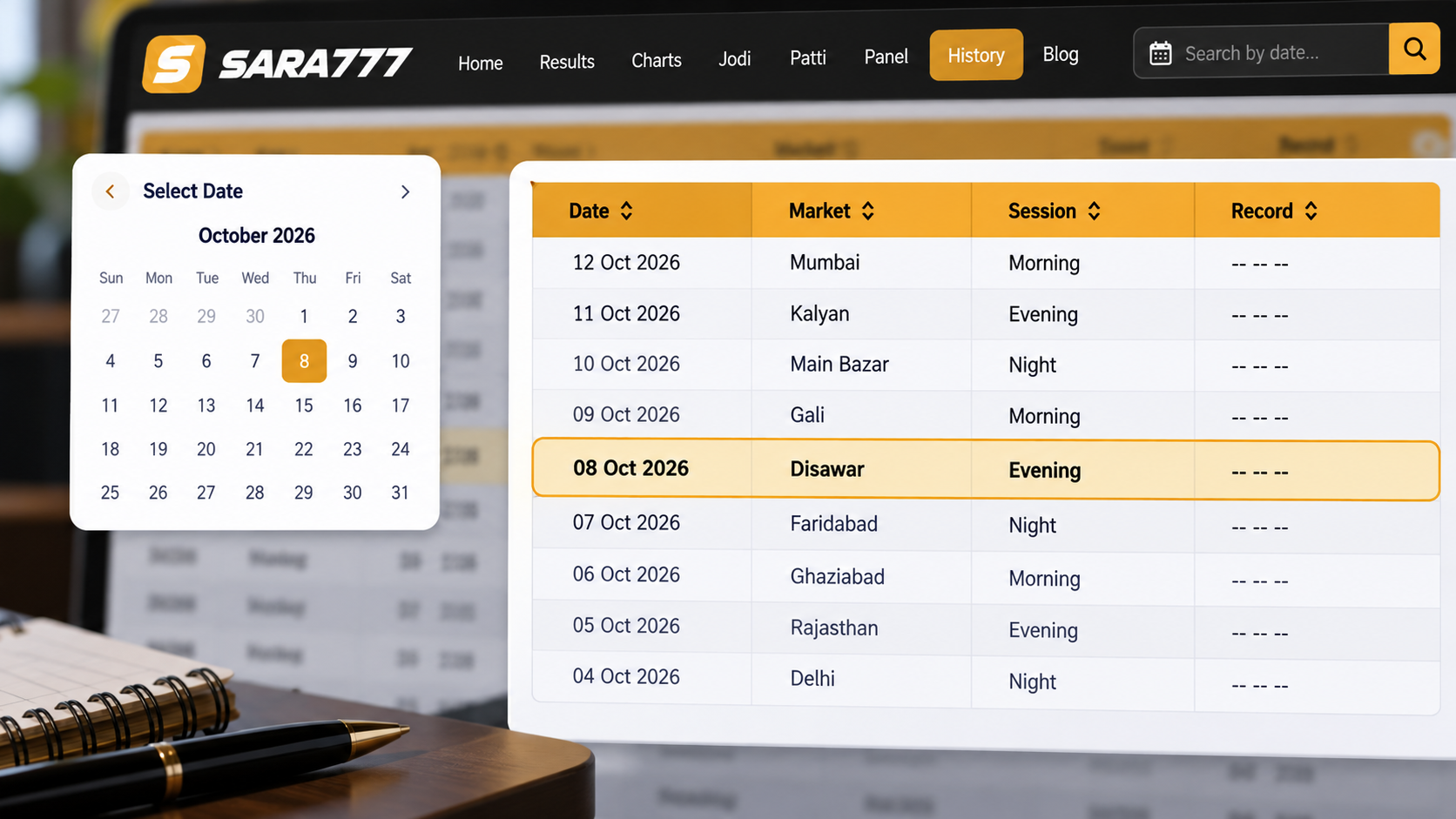
When reviewing historical Matka records or tracking live updates, users often notice apparent chronological contradictions. A live notification might show a page update at 3:54 PM for a draw scheduled at 3:45 PM. A night market draw declared in the early morning hours of Tuesday might be filed under Monday’s historical chart. And server logs in cloud databases might display timestamps hours behind the clock on an Indian user’s smartphone. These differences do not indicate errors; rather, they reflect the necessary separation between Result Time, Page Update Time, and Archive Date.
In software engineering and data auditing, confusing physical occurrence time with business session date is one of the most common sources of corrupted records. Understanding why these three temporal markers diverge is essential for auditing historical charts on the Sara777 Charts Portal, verifying settlement records, and recognizing how modern results platforms maintain chronological accuracy.
The Three Fundamental Temporal Markers
Every recorded result in a structured database possesses three distinct temporal properties:
| Temporal Marker | Technical Definition | Practical Example |
|---|---|---|
| 1. Result Time (Event Timestamp) |
The exact moment the physical draw was conducted or officially declared by the market organizers. | Kalyan Open draw declared at 3:51:30 PM IST. |
| 2. Page Update Time (Ingestion / Publish Timestamp) |
The exact moment a web platform ingested, validated, and rendered the result to public view. | Frontend cache refreshed and displayed the record at 3:53:15 PM IST. |
| 3. Archive Date (Session / Business Date) |
The operational business day to which the draw belongs on historical charts and settlement ledgers. | A 12:50 AM draw filed under 19 October 2026 because it completes Monday’s session. |
Why Page Update Time Differs From Result Time
A results website does not generate physical draw numbers in a vacuum; it functions as a digital transmission and verification network. The interval between when a draw takes place and when a webpage refreshes with the new digits stems from several technical stages:
1. Ingestion Polling Cycles
Platforms that aggregate market declarations rely on automated polling services, webhooks, and manual entry verification desks. Polling jobs operate on scheduled intervals (such as every 30 or 60 seconds). If a result is declared at 3:51:05 PM and the ingestion worker runs at 3:51:30 PM, an automatic 25-second delay is introduced before data ingestion begins.
2. Multi-Source Verification and Quorum Auditing
High-integrity reporting systems do not publish the first unverified text string that appears across social messaging channels. Fraudulent announcements, spoofed screenshots, and retracted numbers occur routinely across informal networks. To maintain publication reliability, editorial platforms cross-verify initial declarations against secondary market sources before committing the record to the production database. This verification gate adds a measured delay of 1 to 4 minutes, ensuring that published numbers are authentic.
3. Cache Invalidation and Content Delivery Networks (CDNs)
Modern websites use Content Delivery Networks (CDNs) to serve millions of visitors without crashing origin servers. CDNs store static and edge-cached copies of web pages:
- When an admin or automated pipeline writes a new result to the database at 3:52 PM, a cache invalidation signal is dispatched to edge nodes.
- Until that cache purge propagates globally, visitors in different regions may view a cached page displaying a pending status for 30 to 90 seconds.
- A browser hard refresh (bypassing local client caching) displays the new page update timestamp.
The Midnight Boundary Problem: Why Archive Date Differs From Calendar Time
The most pronounced discrepancy occurs between the physical clock time of a draw and its historical Archive Date. This occurs in night markets whose operational sessions cross midnight.
Consider a standard schedule for a market like Milan Night or Rajdhani Night:
| Market Session | Scheduled Physical Time | Physical Calendar Date | Official Archive Date |
|---|---|---|---|
| Open Draw | 11:50 PM IST | Monday, 19 October | 19 October 2026 |
| Close Draw | 12:50 AM IST | Tuesday, 20 October | 19 October 2026 (Monday) |
Notice the critical distinction: the physical clock marks the Close draw at 12:50 AM on Tuesday. However, in wagering logic, the Open draw and Close draw form a single unified Jodi that belongs entirely to Monday’s market session.
If a database naively indexed historical charts by the physical calendar timestamp (using DATE(draw_time)), Tuesday’s historical chart row would receive an isolated Close digit with no Open, while Monday’s chart row would be permanently missing its completion!
The Business Date Rule
To prevent historical chart fragmentation, platforms assign an explicit session_date to every market cycle. Any post-midnight draw that serves as the closing leg of a previous evening’s market is bound to that evening’s archive date.
Delayed Declarations and Next-Day Backfills
A second reason why Archive Date and Page Update Time diverge is the occurrence of delayed declarations.
In physical markets, technical difficulties, local curfew orders, festival interruptions, or administrative disputes occasionally delay a draw declaration by several hours or overnight. Suppose a Friday evening draw could not be verified until Saturday morning at 9:00 AM:
- Result Time: Saturday, 9:00 AM IST (when the outcome was finally declared).
- Page Update Time: Saturday, 9:05 AM IST (when the platform published the verified entry).
- Archive Date: Friday (the business date under which bets were staked and settled).
If the platform assigned this delayed result to Saturday’s archive row, Saturday would show two duplicate draws, and Friday’s row would appear as a missing record. Proper archival requires placing the result on the date the session was held, while clearly preserving the ingestion timestamp in system metadata.
Timezone Normalization: UTC Server Clocks Versus IST Operations
In modern web development, servers hosted on global cloud infrastructures (such as AWS, Google Cloud, or Azure) operate by standard default on Coordinated Universal Time (UTC). Indian markets, however, operate exclusively on Indian Standard Time (IST, UTC+05:30).
This 5-hour and 30-minute offset frequently leads to calendar date confusion if not properly normalized:
Physical Draw Time in Mumbai: 01:00 AM IST (Tuesday, Oct 20)
Raw Server Timestamp in Cloud: 19:30:00 UTC (Monday, Oct 19)
Offset: 5 hours 30 minutes behind
If backend SQL queries group records using an unadjusted UTC timestamp (such as GROUP BY CAST(created_at AS DATE)), all draws occurring between 12:00 AM midnight and 5:30 AM IST are categorized under the preceding calendar day. Professional platforms explicitly enforce Asia/Kolkata timezone conversion across database tables, API payloads, and frontend templates to ensure uniform reporting.
Why Preserving All Three Markers Matters for Transparency
Publishing and preserving these three timestamps is a core requirement for historical integrity:
- Settlement and Dispute Auditing: Knowing the exact Result Time verifies whether a wager was placed strictly before the market closed, preventing post-cutoff dispute claims.
- Tamper-Evident Publishing: Maintaining an unalterable Page Update Time provides a digital audit trail proving whether an entry was published live during declaration or altered hours after the fact.
- Continuous Chart Historiography: Proper Archive Date mapping ensures that historical tables—such as the Kalyan Jodi Chart and Kalyan Pana Chart—preserve full pairs and unbroken chronologies, preventing the statistical distortions analyzed in our report on how missing dates distort frequency counts.
Conclusion
When reading historical charts or tracking live updates on Sara777, recognizing the distinction between Result Time, Page Update Time, and Archive Date removes confusion. A draw that took place at 3:51 PM, published at 3:53 PM, and filed under its designated session date represents the coordinated operation of physical events, digital verification pipelines, and historical record-keeping working together.