

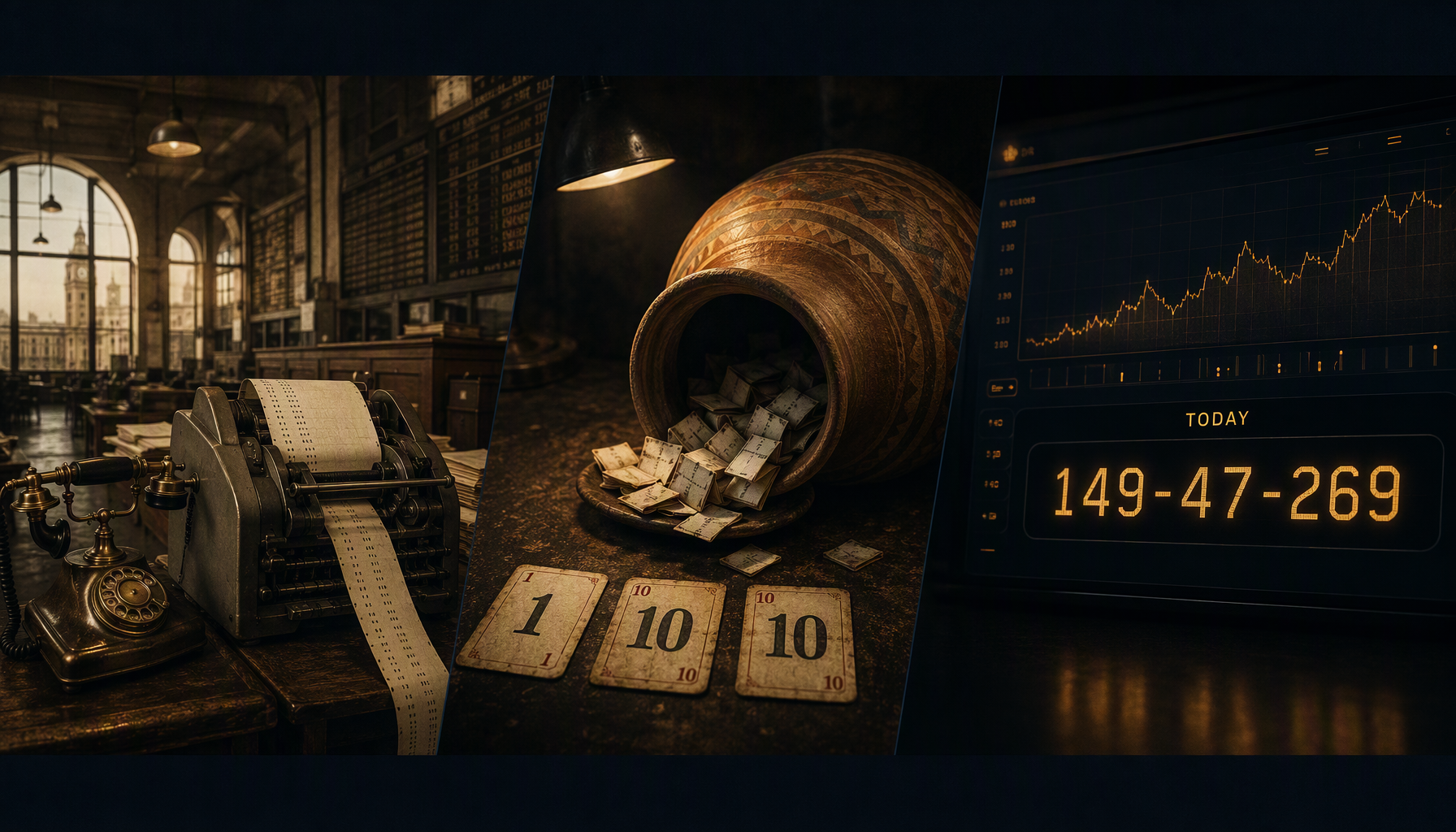
Satta Matka began in Bombay as betting on the opening and closing rates of cotton transmitted from the New York Cotton Exchange, and it became the game recognised today in four transitions: when the New York exchange withdrew that cotton channel in 1961 the betting detached from commodity prices and moved to numbers written on paper slips drawn from an earthen pot — the matka that gave the game its name; the pot was then replaced by playing cards, which fixed the three-digit draw and the last-digit sum that every chart still prints; named markets such as Kalyan and Milan were built around those mechanics in the 1960s and 1970s; and after police action dispersed the street parlours through the 1990s the same arithmetic migrated to online charts and apps. Nothing in the numbering system changed on the way.
What This Timeline Can and Cannot Prove
Matka history is mostly oral history, repeated across sources of very different quality, so this page separates three levels of confidence rather than presenting folklore as fact:
- Documented. The cotton-rate origin, the 1961 withdrawal of the New York cotton channel, the earthen-pot slip draw, Kalyanji Bhagat starting the Worli operation in 1962, Ratan Khatri's role in the card-draw format and his detention during the Emergency, the 1990s Mumbai Police crackdown, Khatri's death in May 2020.
- Widely reported but not independently verified. Turnover figures, the exact year each individual market began, and the story that the Kalyan market is named after its founder — the naming is attributed to Kalyanji Bhagat in most accounts and is treated here as attribution, not record.
- Not verifiable at all. Every claim circulating online about a system, formula or inherited trick that beat the draw. No source in the documented record supports one, and none is needed to explain how the game works.
Era 1: Cotton Rates, Not Numbers (Up to 1961)
The earliest form of the game had no cards, no pot and no three-digit result. In Bombay's cotton trading district, clerks and speculators bet on the opening and closing rates of cotton as those figures were transmitted from the New York Cotton Exchange. Two published numbers per day, one at the start of trading and one at the close, produced two natural betting events — and that pairing is the ancestor of the Open and Close sessions still printed on every chart today.
The transmission channel itself is what ended this era: in 1961 the New York exchange withdrew the cotton arrangement the Bombay bettors depended on. The betting did not stop; it simply lost its external source of numbers and had to generate its own.
Era 2: The Pot and the Slips (1961 Onward)
With no exchange feed to consult, organisers wrote candidate numbers on pieces of paper and drew them from a matka — a large earthen pitcher. Satta means betting or speculation, so the compound name describes the mechanism honestly: a bet settled by drawing from a pot.
This is also the moment the game's vocabulary was set. The words still used on Sara777 charts — defined individually in the terminology glossary — come from this period rather than from the software era, which is why a term such as Patti literally refers to the paper slips and why "market" survived the death of the actual trading floor.
Era 3: Playing Cards Fix the Arithmetic
Paper slips in a pot were easy to rig and awkward to scale. The reported next step, associated with Ratan Khatri, was to draw three cards numbered 1 to 10 and record the result as the three numbers drawn, with their total reduced to a single digit.
That change explains two features that otherwise look arbitrary on a modern chart:
- Why a result is three digits. Three cards, three digits — the Pana, still the atomic unit of a declared result.
- Why the Ank is the last digit of a sum rather than the sum. Three cards drawn from 1–10 can total anywhere from 3 to 30. A total of 24 cannot be a single digit, so the value used for matching became the unit digit. That is why
149produces Ank4rather than 14, and why sums above 9 are routine rather than exceptional — the full derivation is worked through in the step-by-step results reading tutorial.
When cards were themselves replaced by generated numbers, the shape of the record was already frozen. A Sara777 line such as 149-47-269 is the same object a card draw produced half a century ago.
Era 4: Named Markets and Their Founders (1960s–1980s)
The game's second structural change was organisational. In 1962 Kalyanji Bhagat started the operation at Worli that grew into the market now known as Kalyan — the name is generally traced to him, which is how a founder's given name still appears as a column heading on a chart page. Ratan Khatri, later described in the press as the "Matka King", is the figure most accounts associate with the three-card draw and with building out the Milan markets.
Naming a market did three things at once: it gave bettors a stable schedule to plan around, it gave the archive an owner to be checked against, and it made each market's record independent of every other. That last consequence is still the most important practical fact about the game — Kalyan and Milan Night keep separate records and separate charts, and nothing transfers between them.
Khatri's own trajectory marks the era's limits. He was detained for roughly 19 months during the Emergency (1975–77), his business contracted under police pressure through the 1990s, and he retired from operations in 1993. He died in Mumbai in May 2020.
Era 5: The 1990s Crackdown and Dispersal
Mumbai Police action through the 1990s dismantled the physical parlour network that had carried the game for three decades. This is the least romantic and most consequential part of the timeline: the crackdown did not end the betting, it removed its location. Operations scattered, records went informal, and the game's legality never changed — Matka has been illegal gambling in most Indian states throughout its history, and no era described on this page was ever a legal one.
Era 6: The Digital Age
Dispersed bettors needed two things a parlour used to supply: a schedule and a trustworthy record. Software supplied both, and the migration followed predictably — first to telephone and internet-based bookkeeping, then to websites and apps publishing result archives directly.
What the digital transition genuinely changed:
| Aspect | Parlour era | Online era |
|---|---|---|
| Result record | Told verbally or written in a ledger held by one operator | Published on a dated chart page anyone can open and re-check |
| Historical lookup | As far back as the shopkeeper's memory and notebooks | Multi-year weekly archives, searchable by result |
| Schedule | Known locally, varied by area | Fixed open and close times printed per market in IST |
| Verification | Trust in the operator | Compare the same record on two chart views of one archive |
| Reach | Neighbourhood | Anywhere with a phone — which is also where the risk scales |
What did not change: two sessions per market per day, a three-digit Pana per session, an Ank taken from the last digit of that sum, a Jodi derived from both Anks rather than drawn, and a result that cannot be re-declared once published. The mechanics are older than the software displaying them.
Where the Past Still Shows in Today's Schedules
The clearest surviving artefact is the naming. Of the 25 main markets on a platform schedule, a large share are place names from the game's physical era — Dadar, Parel, Worli, Gali, Faridabad, Ghaziabad, Kalyan, and the two markets that carry Mumbai itself. Others name a trading venue rather than a locality: Time Bazar, whose one-hour window is itself a relic of a scheduled market day, and Main Bazar. The rest — Sridevi, Madhur, Rajdhani, Supreme, Milan, Kuber, Disawar — are named after the operations that established them.
The newer families are digital-era additions rather than inheritances. Starline games, which declare across several timed slots in a day instead of one Open and one Close, and Jackpot draws with their own bet types, exist because software can run a schedule a parlour could not keep. A modern platform therefore carries two histories at once: a 1960s structure for the main markets, and slot-based formats that only became practical later.
How the Record Itself Changed
The most underrated change in the whole timeline is not the drawing method but the archive. A result that used to exist only in a ledger now sits in a dated grid, and the same record is rendered twice — in full on a market's Pana chart, such as the Kalyan Pana Chart, and reduced to its two Jodi digits on that market's Jodi chart. That is a verification capability no parlour customer ever had: any past day can be reopened, its sums re-checked, and its digits compared against a second view of the same data.
It also closes the loop on the folklore problem. Once a claim about a pattern can be tested against a complete archive instead of a remembered highlight, most such claims stop surviving contact with the record — which is the honest reason the history of this game contains no famous winning system.
Frequently Asked Questions About Matka History
Who invented Satta Matka?
No single inventor. The cotton-rate betting that preceded it was a trading-floor practice, not one person's idea. The named figures belong to the next stage: Kalyanji Bhagat, who started the Worli operation in 1962 that became the Kalyan market, and Ratan Khatri, associated with the three-card draw and the Milan markets.
Why is it called "Matka"?
From the earthen pot the numbers were drawn from once the game detached from cotton rates. Satta is the betting half of the name. The pot itself disappeared from the mechanism decades ago and the word remained.
Is the game played today the same as the original?
Structurally yes. Two sessions a day, three digits per session, a single-digit value taken from the sum, and a two-digit combination derived from the two sessions — that framework was fixed by the card era. What changed is where the numbers come from, who holds the record, and how many people can see it.
Did moving online change the odds?
No. Distribution, chart presentation and record-keeping all improved; the relationship between a bet and a declared result did not. Online platforms changed how easily a person can lose money, not how often. The safety consequences of that difference are covered in the online Matka safety and security rules.
Why do markets carry the names of Mumbai localities?
Because the game was run street by street before it was run on screens, and the localities where operations sat — Dadar, Parel, Worli, the lanes the Gali market is named for — stayed attached to the schedules. The map of the old trade is still readable on a current market list.
Is there any historical evidence that predictions work?
None in the documented record, and the reason is structural: each market's sessions are independent events, so a completed archive contains no information about the next declaration. Every claim of a proven historical method belongs to the unverifiable category above, not the documented one.
Historical Notice: This article records how the game developed; it does not recommend participating. Satta Matka has been illegal gambling in most Indian states across its entire documented history, the 1990s police action that reshaped it was a crackdown on an unlawful trade, and the modern online form carries the same legal exposure plus real financial risk. It is for adults only. Check the law in your own state before acting on anything described here.