

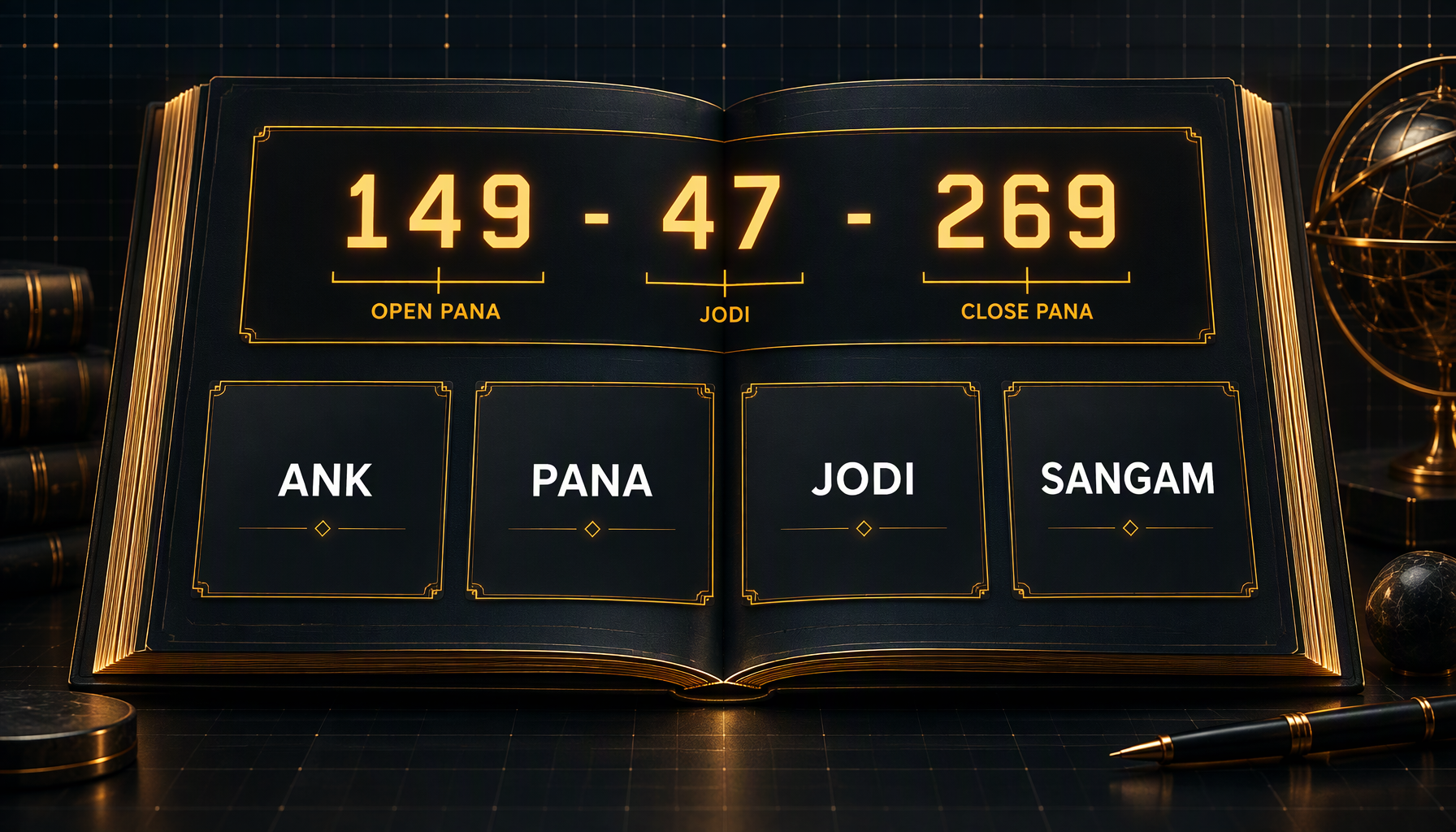
Satta Matka vocabulary is small but overloaded: the same object is called a Pana, a Panna or a Panel depending on who wrote it, and the word "Single" means a one-digit bet in one sentence and a three-digit result in the next. This glossary fixes each term to one definition, in alphabetical order, and marks where that word actually appears on Sara777 charts, market pages and result lines. It is a reference, not a tutorial — if you want the words put to work, the beginner's guide to what Satta Matka is and the step-by-step results reading tutorial cover the doing.
How to Read Each Entry
Every entry gives the term, the spellings and synonyms used for it in the wider Matka world, a single definition, and the place on the platform where you will meet it. Where a term has a full article devoted to it, the entry says so in one line and moves on rather than repeating that article. Anything a platform calls a status or a type is written here the way the system labels it, so a screenshot you save and a chart page you open describe the same thing.
A — C
Ank (Digit)
The single digit 0–9 obtained by adding a Pana's three digits and keeping the last digit of that sum. For 149 the Ank is 4 (1+4+9 = 14). An Ank always belongs to one session: there is an Open Ank and a Close Ank, and they are different numbers on the same day. On charts, Anks appear as the two middle digits of a result line — never as a drawn number in their own right.
Bazar / Bazaar (Market naming)
A traditional suffix meaning the market itself, as in Time Bazar or Main Bazar. It carries no separate meaning from "market" — it is part of the proper name, and the spelling varies between platforms for the same market. Treat Time Bazar and Time Bazaar as one market, and confirm the schedule printed on the page rather than the spelling.
Chart (Jodi Chart / Pana Chart)
The historical archive of a single market, laid out week by week from Monday to Sunday. A Jodi Chart shows only the two derived middle digits of each record; a Pana Chart shows the whole line — Open Pana, Jodi, Close Pana. Same archive, different projection. The Kalyan Jodi Chart explained covers how a specific market's chart is organised.
Cut Ank
A guesswork term used in tip and formula communities for a digit said to be carried forward from an earlier result by some unofficial rule. It is not a platform term: no Sara777 chart column, result field or bet format is called Cut Ank, and nothing of the kind is stored for a market. You will meet the word on forums and in WhatsApp forwards, not on a chart page.
D — H
Day / Night suffix
Marks two independently scheduled markets that share a name stem — Milan Day and Milan Night, Madhur Day and Madhur Night, Rajdhani Day and Rajdhani Night. They have different opening and closing times, different result records, and different charts. A line declared for Milan Night is not a record for Milan Day on the same date, and pattern-spotting across the two is comparing unrelated draws.
Declared vs Saved
The platform distinguishes a result that has been entered internally from one that has been published and settled. A saved session result exists in the system but is not yet released to players; a declared result is published, is visible on charts, and has had the bets against it settled. Only declared results are public records — the statuses are listed together under Result Status.
Double Pana
A three-digit Pana in which exactly two of the three digits are identical — 112, 100, 223. The repeated pair may sit in any two positions. A Double Pana is a result classification, not a session: the same three-digit record is classified Single, Double or Triple purely by how many distinct digits it contains.
Gali
A market name, one of the late-night main markets, declared close to midnight. It is frequently mistaken for a generic word for the night session of some other market; it is not — it is its own named market with its own schedule and its own chart archive.
I — L
IST (Indian Standard Time)
Every opening time, closing time and declaration time on the platform is printed in Indian Standard Time, UTC+05:30. Nothing is shown in your local time zone. A result you believe is an hour late is usually a time-zone conversion, so convert against IST before judging whether a market has missed its schedule.
Jodi
The two-digit bracket in the middle of a result line, formed by writing the Open Ank first and the Close Ank second. In 149-47-269 the Jodi is 47. It is derived, never drawn, which is why it is the last part of a day's record to become known. Order matters: 47 and 74 are different Jodis, because the first digit must come from the Open session and the second from the Close.
Jodi Panel
Used two ways in Matka writing — sometimes for the Jodi itself, more often for the weekly grid that lists a market's Jodis, i.e. the Jodi Chart. On Sara777 the chart view is the intended meaning, and the two digits are the Jodi. When a source is ambiguous, decide which of the two the writer needs for their sentence.
Logical Market Date
The date a market's day record is filed under, which the platform derives from that market's own schedule rather than from the clock at the moment you open the page. For a market whose close falls after midnight relative to its open, the day belongs to the earlier calendar date. This is why the date printed on a record is authoritative and a memory of "what day it is now" is not.
M — P
Market
A named game with its own schedule and its own independent archive — Kalyan, Time Bazar, Sridevi, Disawar, Milan Night, and the rest. A market is the unit a chart belongs to, the unit a result is declared for, and the unit a bet is placed against. Nothing crosses between markets.
Market Day
One market on one market date: the record that holds that day's Open result, Close result, and result status. When players say "today's Kalyan", the platform's object is a Market Day. A Market Day with no results at all is not the same as a missing record — see No Draw under Result Status.
Market Type (Main / Starline / Jackpot)
The platform groups its games into three families. Main markets run one Open and one Close draw per day and produce the classic eight-digit line. Starline games run several timed slots per day, each declaring its own three-digit Pana. Jackpot games are separately scheduled draws with their own bet types and their own result records. The type determines which vocabulary applies — Jodi and Sangam are Main-market words.
No Draw
A scheduled day on which a market produced no result. On charts it appears as the placeholder rather than a number, and it is distinct from a day still waiting for its draw. The full set of reasons a chart shows asterisks — including historic dates before a market's records begin — is covered in why Sara777 charts show stars.
Open / Close (session)
The two draws a Main market runs in a day. Open comes first and its printed time is the earlier one on the market page; Close follows. Each has its own betting window, its own Pana, its own Ank, and its own settlement. Every single-digit and Pana bet names one of the two; that naming is the difference between a win and a loss on the same day.
Pana / Panna / Panel
Three spellings of one thing: the three-digit number declared for one session. The chart pages label it both Pana and Panel on the same screen — the page heading reads "Pana Chart" while the archive section is captioned "Panel Chart Records" — and Panna is the spelling used in bet format names. Panel is older trade spelling you will also see in third-party charts. 149, 269, 777 are all Panas. Digits are read position by position — 149 and 194 are two different Panas.
Patti
Traditional Matka word for the three-digit combination, from the slips originally drawn from the pot. In current platform usage the same object is called a Pana, and the phrase "Patti betting" maps onto Pana betting. Where a source lists "Patti rates", it means the payout attached to hitting that three-digit number, which varies by format.
Payout Rate
The multiple applied to a winning stake for a given bet format. Each format has its own, they differ between formats rather than being one site-wide number, and they are set per platform. This glossary defines the word only: the actual figures and the comparison between formats belong to a dedicated payouts reference, and quoting them here would go stale the moment a platform adjusts a single one.
Placeholder (*** ** ***)
What an undeclared part of a result line is drawn as: three asterisks for an unknown Open Pana, two for an unknown Jodi, three for an unknown Close Pana. A partially declared day mixes forms — 149-4*-*** is an Open Pana known, its Ank derived, and the Close still pending. On the homepage result row the separators between the groups may render as underscores instead of dashes; the digit groups themselves are unchanged.
R — S
Red Jodi
A Jodi that a chart highlights in red rather than showing in the ordinary colour. Two digit shapes qualify: both digits identical, or the two digits exactly five apart. So 22 and 27 are Red Jodis; 26 is not. The highlighting is a display convention, not a different kind of record — the underlying result is derived the same way, and the Kalyan chart guide expands on the terminology in its own section.
Result Status
Where a Market Day has reached in its result cycle. The platform's labels are these, and only these:
| Status | Meaning |
|---|---|
| None | No result exists for the day yet and the cycle has not begun. |
| Pending | The market's schedule has passed with no result entered; the day is awaiting one. |
| Open Saved | The Open session's result is entered internally but not yet released. |
| Close Saved | The Close session's result is entered internally but not yet released. |
| Open Declared | Open is published and bets on it settled; Close is still ahead. |
| Close Declared | Close is published and settled. |
| Full Declared | Both sessions published and settled — the day's line is complete. |
A day cannot reach Close Declared before its Open result exists; the sequence is enforced, not customary.
Sangam
A bet format that combines both sessions of one day in a single wager, which is why it settles only after the Close result is declared. Three varieties exist and they are not interchangeable:
- Half Sangam A — an Open Ank digit plus a Close Pana.
- Half Sangam B — an Open Pana plus a Close Ank digit.
- Full Sangam — an Open Pana plus a Close Pana.
Which side carries the digit and which carries the Pana is the entire difference between A and B, and it is the most common way a Sangam record is misread. The betting rules around them are in the rules guide for new players.
Session Lock (betting deadline)
The moment a session's betting stops for that day, which is the moment its result is declared. Locks are per session, not per market day, and one format can lock earlier than the rest: Jodi betting closes for the day as soon as the Open result is declared, because the Jodi's first digit is already fixed.
Single
The most overloaded word in Matka, with three live meanings. A Single bet is a one-digit wager on one session's Ank. A Single Pana is a three-digit result whose digits are all different, such as 149. A Single digit (or Ank) is any digit 0–9. Which one a sentence means is decided by whether it is talking about a wager or about a declared number — and a note written "Single 5" means the digit, while "Single 149" means the Pana.
Starline
A market family that declares across several named time slots in a day instead of one Open and one Close. Each slot has its own scheduled time and its own three-digit result, from which that slot's single digit is derived. Starline games carry no Jodi and no Sangam, since those need a paired Open and Close; a Starline record is read slot by slot.
T — W
Time Bazar
A market named for the length of its window rather than for a place: it opens and closes one hour apart, in the early afternoon. It is a market like any other, with its own archive, and its one-hour gap makes its lock arrive quickly after opening — a schedule difference, not a rule difference. Not to be confused with the general phrase "time bazaar" used loosely for any daytime market.
Triple Pana
A Pana whose three digits are all identical — 777, 000. Ten of these exist in total, one for each digit, which is why this classification sits apart from Single and Double Panas in both bet formats and result archives.
Settlement
The step that follows a declaration: every bet placed against that session or market day is marked win or lose, winning amounts are calculated at that format's rate, and the results are written to player wallets. A declared result and a settled day are the same event seen from two sides — the chart shows the number, the wallet shows the consequence.
Three Word Pairs That Cause Most Misreadings
If you only take three distinctions away from this reference, take these:
- Pana vs Ank. Three digits versus one. A bet naming a three-digit number is not a bet on a digit, and the archive column they belong to differs.
- Jodi vs the two Anks it came from.
47is not a draw. Its halves come from two different sessions, which is why reversing it is a different answer. - Market Day vs calendar day. The record is filed by market date, derived from the market's schedule. Where those two diverge, the market date wins.
Frequently Asked Questions About Matka Terminology
Is "Panna" the same as "Panel"?
Yes — both are spellings of the three-digit session result, which Sara777 labels Pana. Three spellings for one object is normal in Matka writing; the meaning does not change between them.
Why do sources define the same word differently?
Because much Matka vocabulary travelled by word of mouth before it reached charts, and regional usage hardened different meanings onto the same short words — "Single" above all. Where a term is genuinely ambiguous, this reference gives the platform's own label and says what the other usage means.
Do Starline and Jackpot use the same terms as Main markets?
Partly. Pana, Ank, declaration, settlement and status all apply. Jodi, Sangam and the Open/Close pairing do not, because those depend on exactly two sessions per day. A Starline day has as many results as it has slots.
Is "Red Jodi" a separate result type?
No. It is a display treatment for two digit shapes — identical digits, or digits five apart. The record behind it is derived and settled like any other Jodi.
Where can I see these terms used rather than defined?
On a market's own chart page, where Pana, Jodi, status and placeholder all appear on real dated rows. Reading one complete line from Open Pana to Close Pana in order is the fastest way to make the vocabulary stick, and a worked six-step walkthrough of that line exists on this site for exactly that purpose.
Reference Notice: This glossary records what existing terms and statuses mean on the platform; it does not endorse any way of playing. No term defined here — Cut Ank, formula, pattern, or any other — describes a method that carries information about a future draw, and knowing the vocabulary changes no one's odds. Satta Matka involves real financial risk, is restricted or prohibited in several Indian states, and is for adults only. Check your local laws before acting on anything you read in Matka terms.