

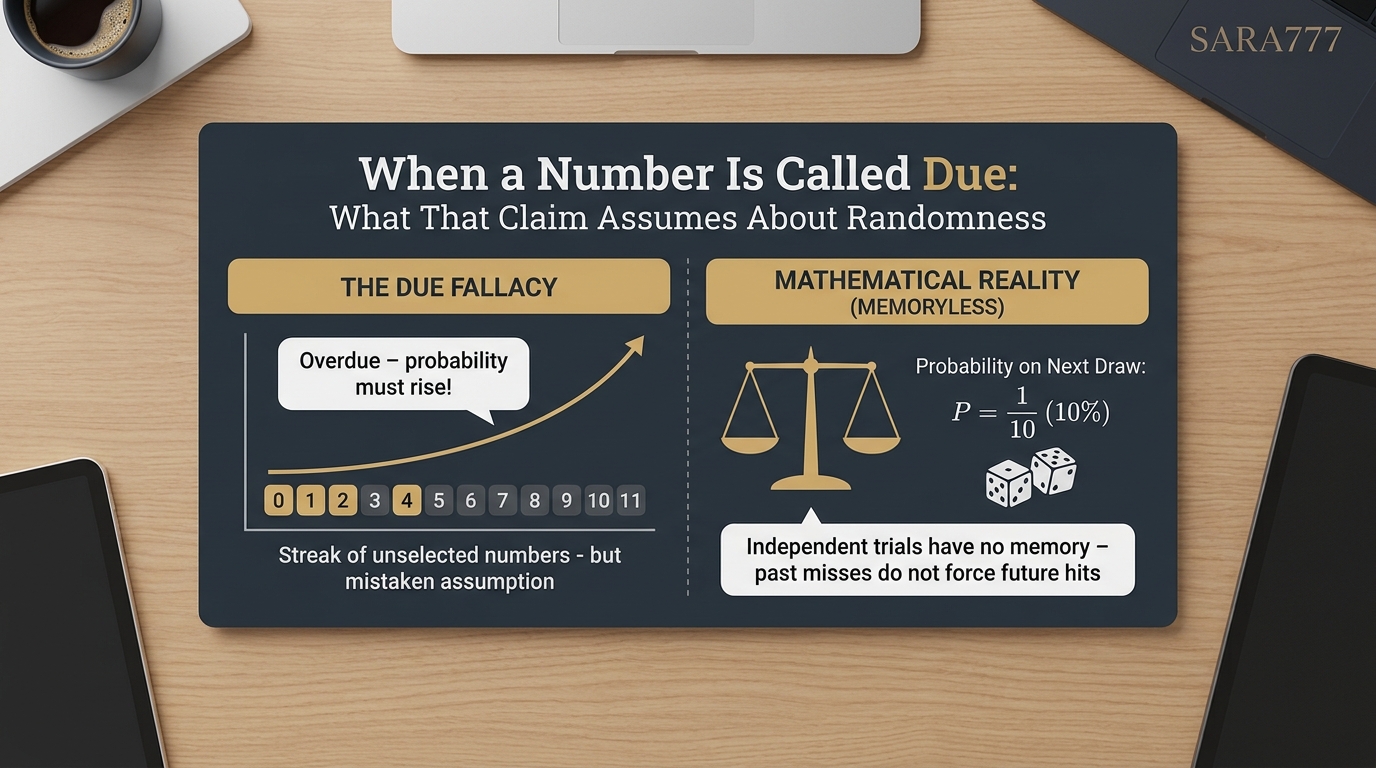
When someone claims a number is “due” to appear because it has been absent from recent chart declarations, that claim rests on a fundamental psychological illusion known as the Gambler's Fallacy. It mistakenly assumes that random processes possess an internal memory, that past absences create an overdue debt, and that the draw mechanism will actively compensate by favoring the missing number in upcoming rounds. In any genuinely independent random process, each trial is completely memoryless: whether a digit appeared yesterday or has been missing for thirty consecutive draws, its mathematical probability on the very next draw remains exactly identical.
The phrase “it is due” is one of the most widely repeated concepts in informal wagering discussions, yet it misrepresents how probability functions in the real world. To evaluate why the claim fails, one must examine the specific mechanics of random trials, separate independent events from dependent sampling, and understand how the Law of Large Numbers actually operates.
The Three Unspoken Assumptions Behind Calling a Number “Due”
When a tipster or chart reader asserts that a specific single digit (Ank) or pair (Jodi) is due, their assertion secretly relies on three unproven assumptions:
- Assumption 1: Historical Memory in the Mechanism: The belief that the physical drum, cards, or algorithm “remembers” which outcomes were drawn previously and adjusts future behavior to balance the tally.
- Assumption 2: Self-Correction Through Compensation: The belief that probability actively intervenes in the short term to correct past deficits, forcing an underrepresented outcome to appear more frequently.
- Assumption 3: The Law of Small Numbers: The psychological expectation that a small sample (such as a 10-day or 30-day chart window) must mirror the long-term mathematical distribution of a theoretical infinite series.
In mathematics, none of these three assumptions hold true for independent events. A random process does not keep a ledger, does not experience guilt over an absent number, and possesses no physical force that compels an outcome to appear simply because time has elapsed.
Independent Trials Versus Dependent Systems
To understand why numbers do not become due, one must distinguish between two fundamentally different types of probability systems:
1. Independent Trials (Sampling With Replacement)
In an independent system, the outcome of any given trial has zero mathematical or physical effect on the probability of subsequent trials. Standard examples include rolling a fair die, flipping an unbiased coin, or drawing a card from a deck and shuffling it back into the deck before the next draw.
If you roll a standard six-sided die and it lands on 4 five times in a row, the probability of rolling a 4 on the sixth roll is still exactly 1 in 6 (16.67%). The die does not know it landed on 4 previously. Each throw is an isolated, independent event.
2. Dependent Systems (Sampling Without Replacement)
A number can only become genuinely “due” (more probable) if the system operates without replacement. Consider a deck of 52 playing cards dealt one by one without reshuffling. If 40 cards are dealt and no Ace has appeared, the probability of drawing an Ace on the next card increases significantly because the pool of remaining cards has shrunk while the four Aces are still in the deck. In that specific physical scenario, past events directly alter the remaining probability distribution.
However, standard daily Matka sessions do not operate as an unreplenished deck over calendar days. Each operating day's draw resets the selection pool completely. Drawing a 7 on Monday does not remove the 7 from Tuesday's drawing pool. Because each session draws from the complete pool of digits, every daily declaration constitutes an independent trial.
The Arithmetic of an Absence Streak: A Hypothetical Model
To make the concept concrete, consider a simple hypothetical model of a single-digit draw selecting one number from the set {0, 1, 2, 3, 4, 5, 6, 7, 8, 9}. Each of the ten digits has an equal theoretical probability of 1 in 10 (p = 0.10) on every draw.
Now suppose you are tracking the digit 7. The probability that 7 does not appear on a single draw is 9 in 10, or 0.90 (90%).
Because consecutive independent draws follow the multiplication rule of probability, we can calculate the exact likelihood of witnessing prolonged absence streaks:
| Consecutive Draws Without Digit 7 | Mathematical Formula | Probability of That Entire Streak Occurring | Probability of Digit 7 on the Next Immediate Draw |
|---|---|---|---|
| 1 Draw | 0.901 | 90.0% | 1 in 10 (10.0%) |
| 5 Draws | 0.905 | 59.05% | 1 in 10 (10.0%) |
| 10 Draws | 0.9010 | 34.87% (roughly 1 in 3) | 1 in 10 (10.0%) |
| 20 Draws | 0.9020 | 12.16% (roughly 1 in 8) | 1 in 10 (10.0%) |
| 30 Draws | 0.9030 | 4.24% (roughly 1 in 24) | 1 in 10 (10.0%) |
Examine the rightmost column carefully. Even after 30 consecutive draws without a single 7, the probability that 7 appears on Draw 31 is still exactly 1 in 10 (10.0%).
Why does this confound human intuition? Before the streak begins, observing a 30-draw drought is relatively rare (4.24%). But once you have already lived through 30 misses, those 30 misses are in the past. Probability does not look backward to settle old scores; it evaluates only the conditions of the current draw.
Dilution Versus Compensation: How Probability Balances
People often ask: “If the Law of Large Numbers guarantees that each digit appears 10% of the time, doesn't an absent digit have to appear more often to restore the balance?”
This question reveals the core misunderstanding. The Law of Large Numbers achieves statistical balance through dilution, never through compensation:
- Compensation (The Fallacy): The belief that if an outcome falls behind by 10 hits, the system produces a cluster of that outcome to erase the 10-hit deficit.
- Dilution (The Mathematical Truth): The initial deficit of 10 hits is never erased. Instead, as thousands of new independent draws take place, that fixed deficit of 10 is divided by an increasingly massive denominator, reducing its percentage impact until it approaches zero.
10 deficit ÷ 100 draws = 10% distortion
10 deficit ÷ 10,000 draws = 0.1% distortion
10 deficit ÷ 1,000,000 draws = 0.001% distortion
The anomaly is swallowed by scale, not corrected by compensation.
Real-World Systems: Why Independence Must Be Examined
In pure mathematics, independence is defined axiomatically. In the physical world, however, one must never blindly declare a system independent without examining its actual mechanism.
Physical randomizers can suffer from mechanical defects:
- Worn edges on physical tiles or cards that cause certain numbers to be selected more often.
- Unbalanced lottery drums where heavier balls settle to the bottom.
- Flawed pseudo-random number generator (PRNG) algorithms with uneven seed distributions.
Crucially, however, if a physical mechanism is flawed or biased, it produces recurring favorites, not “due” underdogs. A mechanically biased drum will repeatedly draw the favored ball; it will never suddenly decide to draw the missing ball to restore balance. Therefore, whether a draw is perfectly random or physically imperfect, the idea that an absent number is “due” is rejected by both pure mathematics and physical mechanics.
What This Means When Reading Sara777 Charts
Historical charts published across the Sara777 Charts Directory—such as the Kalyan Jodi Chart and the Kalyan Pana Chart—exist to provide verified, tamper-evident records of past declarations. They document what occurred on each calendar date for transparency and settlement auditing, as detailed in our guide on what a full Pana record preserves.
Reading these historical tables as forecasting tools creates a dangerous cognitive trap. A cell displaying an empty streak indicates what happened in past weeks, not what must happen next. Recognizing that independent draws have no memory protects readers from confusing historical record-keeping with future certainty.