

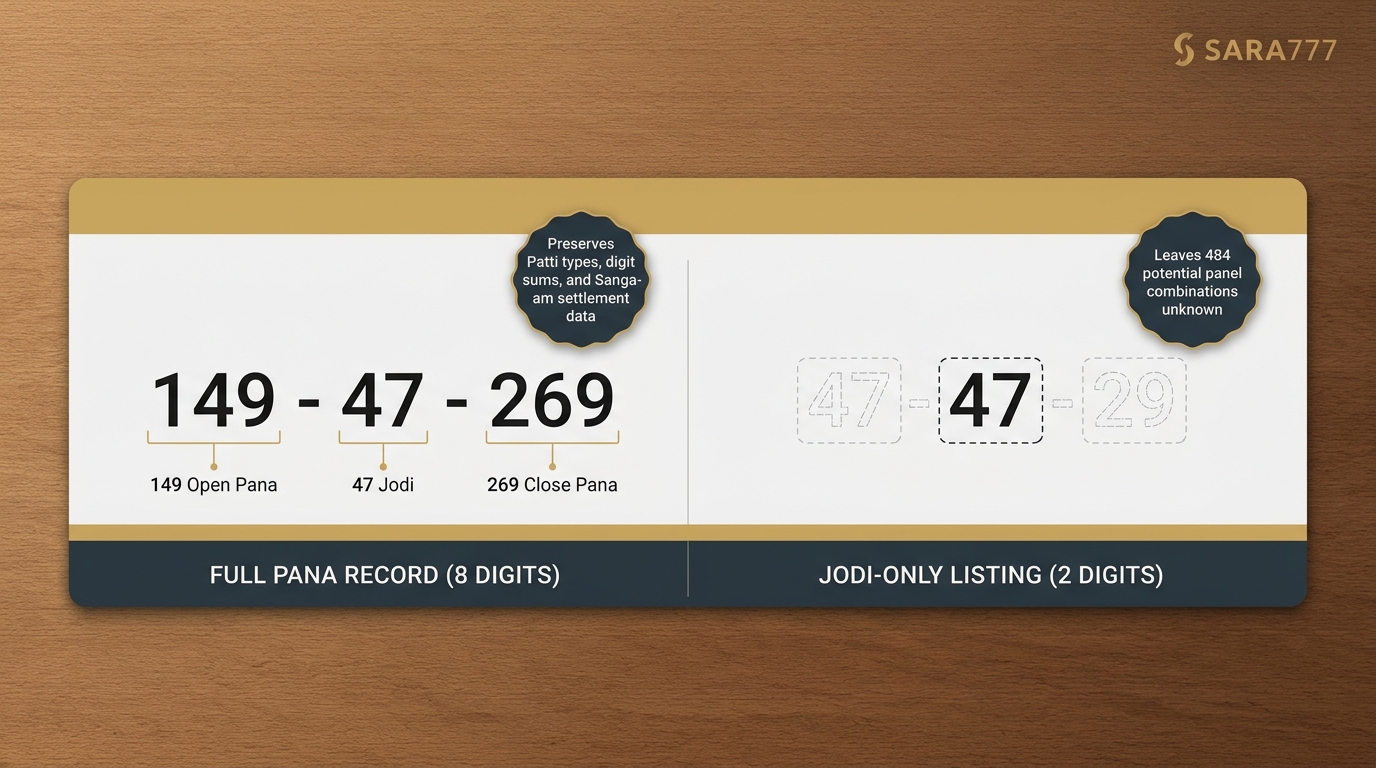
A full Pana record preserves the complete eight-digit declaration of a market day—structured as Open Pana - Jodi - Close Pana—capturing the exact three-card combinations drawn in each session, their Patti classification, and the pre-modulo arithmetic sum that produced the final outcome. In contrast, a Jodi-only listing is a lossy mathematical projection that retains only the two middle digits. By discarding the six surrounding panel digits, a Jodi entry collapses 484 distinct Pana combinations into a single two-digit pair, permanently erasing the evidentiary data required to audit or settle five major wagering formats.
When browsing market archives on results portals, readers often wonder why platforms maintain two separate chart pages for the exact same operating day. The distinction is not merely aesthetic. It represents the difference between a comprehensive primary record and an abbreviated secondary summary. Understanding what the full record preserves—and what the compressed listing omits—reveals how numerical records function across the Sara777 platform.
The Two Record Formats Side by Side
Every standard Satta Matka declaration consists of two distinct drawing events: an Open session and a Close session. Each session draws three numbers between 0 and 9, arranged in ascending order to form a three-digit Pana (also known as a Patti or Panel). The sum of these three digits is calculated, and the unit digit (the final digit of the sum) becomes the session's Single Ank. Combining the Open Ank and Close Ank produces the two-digit Jodi.
How these numbers are recorded determines how much information survives in the historical archive:
| Record Dimension | Full Pana Record (8 Digits) | Jodi-Only Listing (2 Digits) |
|---|---|---|
| Displayed String Structure | 149 - 47 - 269 |
47 |
| Open Session Data | Three-digit panel (149) + Open Ank (4) |
Open Ank only (4) |
| Close Session Data | Three-digit panel (269) + Close Ank (7) |
Close Ank only (7) |
| Arithmetic Proof | Explicitly visible (1+4+9=14 → 4; 2+6+9=17 → 7) | Absent (Ank is presented without derivation) |
| Patti Category Preserved | Yes (Single Patti, Double Patti, or Triple Patti) | No (completely indistinguishable) |
| Settlement Capability | All 7 game formats (Ank, Jodi, SP, DP, TP, Half/Full Sangam) | Ank and Jodi wagers only |
The One-Way Mathematical Trap: Why Jodi Cannot Be Reversed
In computer science and mathematics, a transformation that permanently discards underlying data is called lossy compression. Deriving a Jodi from a full Pana record is a one-way operation. You can always compute the Jodi from the Panas, but you can never reconstruct the Panas from the Jodi.
To understand why, examine how the single digit is produced:
Ank = (Digit 1 + Digit 2 + Digit 3) mod 10
The sum of the three draw digits is reduced to its final unit digit via modulo-10 arithmetic.
In Satta Matka, there are exactly 220 standard ascending Pana combinations. As explained in our breakdown of where the 220 Patti count comes from, these 220 Panas are distributed perfectly evenly across all ten single digits (0 through 9). Exactly 22 distinct Panas sum to any given single digit:
- 12 Single Pattis (SP): Three unique digits (e.g., for Ank 4: 149, 158, 167, 239, 248, 347, 590, 680, 789... summing to 4, 14, or 24).
- 9 Double Pattis (DP): Two matching digits (e.g., for Ank 4: 112, 220, 266, 338, 446, 455, 554, 770, 888... summing to 4, 14, or 24).
- 1 Triple Patti (TP): Three identical digits (for Ank 4: 888, since 8+8+8=24 → 4).
Because 22 different Panas can produce the Open Ank 4, and 22 different Panas can produce the Close Ank 7, the number of distinct Pana pairs that can produce the exact Jodi 47 is:
22 × 22 = 484 potential panel combinations
A Jodi listing of 47 collapses 484 unique real-world Pana outcomes into a single two-digit pair.
If an archive or third-party results table only lists the Jodi 47, 483 possible truths have been discarded. A reader looking at 47 has no way of knowing whether the draw occurred as 149 - 47 - 269, 239 - 47 - 359, or 888 - 47 - 770. The historical event is unrecoverable from the Jodi alone.
Four Critical Data Points Preserved by Full Pana Records
By preserving the complete eight-digit string, a full Pana archive maintains four essential categories of information that a Jodi chart leaves out:
1. The Exact Three Draw Digits
A full Pana record preserves the physical constituents of each drawing session. In markets that draw three numbered cards or balls, knowing that the Open Pana was 149 confirms the exact digits drawn from the pool. A Jodi listing of 4 discards all three constituents.
2. The Patti Category (SP, DP, or TP)
Matka games group outcomes into three fundamental combinatorial tiers: Single Patti (120 combinations), Double Patti (90 combinations), and Triple Patti (10 combinations). Because they have different probabilities, they carry vastly different payout rates—often 140x for Single Patti, 280x for Double Patti, and up to 700x or 900x for Triple Patti. A Jodi listing cannot tell you whether a session resulted in a Single, Double, or Triple Patti.
3. The Pre-Modulo Arithmetic Sum
When three digits are added, their sum can fall anywhere from 0 (for 000, which in bazaar convention counts as 30 → 0) to 27 (for 999 → 7). For an Ank like 4, the sum could have been 4 (e.g., 112), 14 (e.g., 149), or 24 (e.g., 789). A Jodi record discards the tens digit of the sum entirely, retaining only the remainder.
4. Settlement Capability Across All Wager Types
This is the most critical practical distinction. Wagers placed on Single Panna, Double Panna, Triple Panna, Half Sangam, or Full Sangam require the three-digit Pana to determine a winning entry. A bettor who placed a wager on Open Panna 149 cannot verify whether their ticket won from a Jodi listing. Only a full Pana record provides complete settlement verification across every game type supported by the platform.
What a Full Pana Record Does Not Preserve
While a full Pana record preserves the complete mathematical outcome of a draw, readers must avoid assuming it contains metadata that was never recorded in the chart system:
- Exact Draw Timestamps: A chart row records the calendar date and scheduled session, but does not record the exact second or millisecond when the draw was finalized.
- Wagering Volumes or Liabilities: The record displays what was drawn, not how much money was staked, which numbers were heavily backed, or what payout liability the market incurred.
- Physical Drawing Method: The numbers in the record do not indicate whether the draw was executed via traditional physical cards, manual token rotation, or digital random number generation.
- Predictive or Trend Signals: Preserving eight digits instead of two provides complete historical accountability, but past draw records do not alter the independent mathematical probability of future draws.
How to Use Both Views on Sara777
On Sara777, both charts are generated from the same verified daily records. The choice between them depends entirely on your objective:
- Use the Jodi Chart: When your goal is scanning multi-week bracket trends, tracking red Jodi occurrences, or reviewing two-digit outcomes quickly without numerical clutter. You can view this layout on the Kalyan Jodi Chart.
- Use the Pana Chart: When you need to verify an individual session ticket, inspect whether a draw was Single or Double Patti, or audit the complete arithmetic behind a result. You can explore the full format on the Kalyan Pana Chart.
For a direct visual comparison of how cells fill in throughout the trading day, read our detailed guide on Jodi Chart vs Pana Chart: Which One You Need. To explore archives across all major morning, day, and night markets, visit the central Sara777 Charts Directory.