

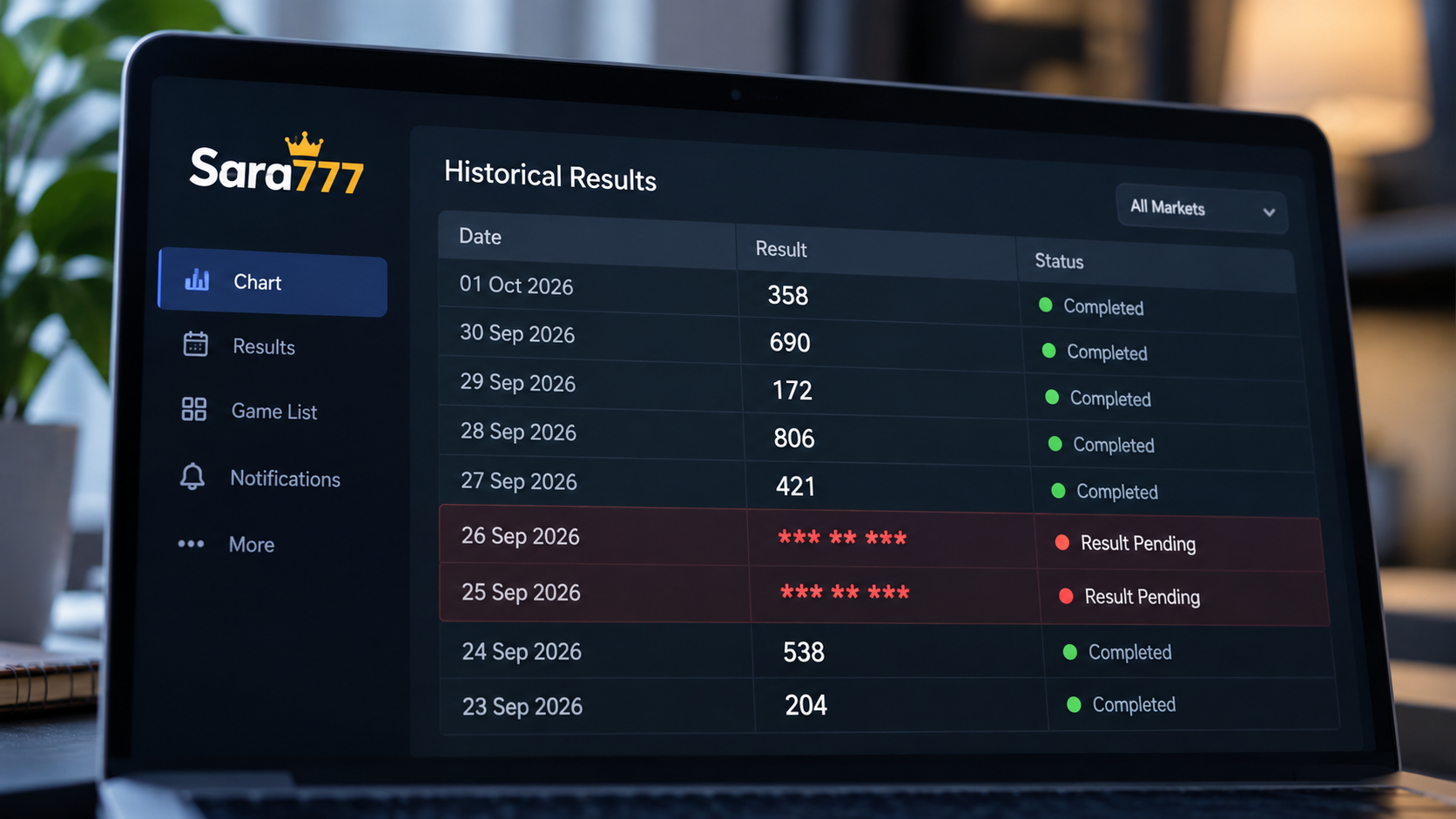
A Maharashtra matka chart is a historical record of past draw results arranged in structured tables. Finding a chart online is easy, but reading one correctly requires knowing session dates, three-digit panel combinations, and draw schedules. This guide explains how Maharashtra Day and Night records work, how Jodi and Panel formats differ, and how to verify entries without believing false prediction claims.
Online searches for Maharashtra chart records often lead to noisy pages. Many sites display unverified numbers, missing dates, or inaccurate claims. Some claim past numbers reveal future winning patterns. Others confuse different market names or post incomplete records during live draw windows.
To read historical archives with confidence, you must separate facts from guesswork. A chart does not predict what will happen next. It is simply a historical record of what has already taken place. Knowing how these tables work helps you check numbers on the Sara777 Charts Portal and spot reliable records.
What Is a Maharashtra Chart Record?
A chart record is an archive table that logs declared draw outcomes for a specific market. Each row lists the date, the opening figures, and the closing figures.
The phrase "Maharashtra chart" carries two meanings in search results:
- Dedicated Market Lines: Many tracking websites list specific lines named Maharashtra Day and Maharashtra Night. These run on fixed daily timetables.
- Regional Category: Matka began in Mumbai in the 1960s. Because of this history, many readers use "Maharashtra chart" as an umbrella term for Mumbai-origin markets like Kalyan, Dadar, Parel, and Old Main Mumbai.
No matter which line you check, a genuine record contains only verified, past facts. It lists the three-digit panel drawn at Open, its single-digit sum, the figures drawn at Close, and the final two-digit pair.
Factual Record vs. Prediction Myth
A legitimate chart record is strictly descriptive, not predictive. Every draw is an independent random event. Legitimate archives preserve past results for transparency and verification. Any site claiming a historical chart contains secret formulas to forecast upcoming numbers is promoting a mathematical myth.
How to Read a Day Chart
A Day chart tracks sessions that take place in the afternoon. For Maharashtra Day market lines, the opening draw usually takes place in the early afternoon, and the closing draw follows about an hour later.
Each row in a Maharashtra Day panel record belongs to a specific calendar date. A full daytime record contains five key parts:
- Session Date: The calendar date of the draw (such as 26 October 2026).
- Open Panel (Pana): A three-digit number drawn in the first session. Digits are listed in ascending order (such as
247). - Open Single Digit (Ank): The unit digit of the sum of the open panel digits (
2 + 4 + 7 = 13, giving single digit3). - Close Single Digit (Ank): The unit digit derived from the closing panel (
1 + 8 + 9 = 18, giving single digit8). - Close Panel (Pana): A three-digit number drawn in the second session (such as
189).
The Open Ank and Close Ank join to form the two-digit Jodi (in this example, 38). In a panel chart, the full record appears as:
247 — 38 — 189
The table below shows how daily entries appear in a verified Maharashtra Day archive:
| Date | Open Panel | Open Ank | Jodi | Close Ank | Close Panel | Status |
|---|---|---|---|---|---|---|
| 26-10-2026 | 247 | 3 | 38 | 8 | 189 | Confirmed |
| 27-10-2026 | 359 | 7 | 72 | 2 | 480 | Confirmed |
| 28-10-2026 | 148 | 3 | 3* | * | *** | In Progress |
Look at the entry for 28 October 2026. The Open panel and single digit are declared. The Close draw has not occurred yet. Reliable systems show stars (3* and ***) for pending fields instead of guessing.
How to Read a Night Chart
A Night chart tracks sessions held during the evening and night. For Maharashtra Night lines, the Open draw usually happens around 8:00 PM to 8:30 PM. The Close draw concludes between 10:00 PM and 10:30 PM.
Reading a night chart requires understanding session dates. Unlike day markets that finish in one afternoon, night draws can lead to date confusion:
- The Session Date Rule: Every draw belongs to the date when the session began. If a night market opens at 10:30 PM on Monday and finishes after midnight at 12:15 AM on Tuesday, the full result is filed under Monday. To understand this in detail, read our guide on why result times and archive dates differ.
- Different Closing Times: Not all night markets follow the same hours. Some finish before 10:30 PM, while others run near midnight. Never assume two night markets share the same timetable.
- Two-Step Updates: During night hours, the open panel remains visible with stars next to it until the close draw concludes.
Understanding Jodi and Panel Records
Maharashtra chart archives come in two common layouts: Jodi charts and Panel (Pana) charts. Both display the same draw events, but each serves a distinct purpose.
| Chart Type | Content Shown | Best Use |
|---|---|---|
| Maharashtra Jodi Chart | Shows only the two-digit pair (like 38) in weekly columns from Monday to Sunday. |
Gives a clean view to check daily pair outcomes across weeks at a glance. |
| Maharashtra Panel Chart | Shows all eight digits: 3-digit Open Pana, 2-digit Jodi, and 3-digit Close Pana (like 247-38-189). |
Provides full records to audit card groups, check math, and verify draw numbers. |
For more on cell structures and formats, see our Satta Matka Jodi & Panel Chart Guide and our side-by-side breakdown in Jodi Chart vs Pana Chart.
How to Verify a Historical Entry
Many websites copy results from other sources. Because of this, typos and missing rows often enter unofficial archives. To verify any historical Maharashtra chart record, use this simple four-step check:
-
Check the Math:
Add the three Open Pana digits. The unit digit of that sum must match the Open Ank. For example, if the open panel is
359, add3 + 5 + 9 = 17. The unit digit is7. If the chart shows any other open single digit, it has a typo. Do the same math for the close panel. -
Check Digit Order:
Standard rules require Pana digits to appear in ascending order (such as
148or225). If a table lists841or953, the site has entered numbers out of order. -
Identify Market Off-Days:
Markets take regular weekly off-days (often Sunday) or public holidays. Accurate archives mark these scheduled breaks with double dashes (
--) or asterisks (**). A missing date with no marker indicates missing data. -
Recognize Valid Zero Results:
A Jodi of
00is a real outcome. It happens when both open and close sums end in zero (such as panel145giving0and panel235giving0). Never mistake a double-zero outcome for a blank or missing entry.
Common Mistakes When Reading Chart Archives
Readers often make avoidable mistakes when checking older records. Watch out for these five frequent errors:
1. Date Mismatches After Midnight
When checking night results, people often look under the next day's date. If a night draw finishes at 11:45 PM on Thursday, checking Friday's column will show empty cells or stars. Always match the result to the session start date.
2. Mixing Up Similar Market Names
Many markets share similar names. Beginners often mix up Maharashtra Day with Madhur Day, Milan Day, or Supreme Day. In the same way, Maharashtra Night is not the same as Kalyan Night or Main Bazar. Always confirm the exact column title before reading numbers.
3. Dropping Leading Zeros in Spreadsheets
When people copy chart data into spreadsheet programs like Excel, cells set as general numbers strip leading zeros. A Jodi of 07 becomes 7, and a panel of 048 becomes 48. This breaks two-digit bracket tracking. On Sara777, leading zeros are stored as text to avoid this error. Read our guide on why Jodi values keep their leading zero.
4. Treating Half-Finished Draws as Complete
During live draw windows, readers often check tables right after the afternoon open draw. Seeing 247-3*, some mistake the open single digit 3 for a finished result. Until the close panel and close digit are declared, the Jodi is incomplete.
5. Believing Historical Patterns Predict Future Draws
The most common error is thinking past numbers predict future outcomes. Some believe that if a number has not appeared for weeks, it is "due" to hit. In probability math, every draw is an independent event with unchanged odds. Past draws have no effect on future results. Charts are historical records, not prediction tools.
Frequently Asked Questions
What is the difference between a Maharashtra Jodi chart and a Maharashtra Panel chart?
A Maharashtra Jodi chart shows only the two-digit pair (such as 38) for each day in weekly columns. A Maharashtra Panel chart shows all eight digits: the three-digit Open Pana, the two-digit Jodi, and the three-digit Close Pana (such as 247-38-189).
Does a Maharashtra Night chart entry belong to the opening date or the closing date?
A night entry always belongs to the date when the session opened. Even if the draw finishes late at night or shortly past midnight, the full row is filed under the session opening date.
What do asterisks (*** ** ***) mean on a Maharashtra chart?
Asterisks mark pending or unreleased draw stages. For an active game, *** shows an open or close panel is not yet drawn, while ** shows the Jodi is awaiting completion. On non-trading days, asterisks mark a planned market holiday.
Can historical Maharashtra charts help predict upcoming numbers?
No. Historical charts only record past results. Every draw is an independent event. Past numbers do not change future odds, and no formula can forecast future results from chart tables.
Why do some Maharashtra chart records show numbers highlighted in red?
In Matka charting, certain Jodi outcomes appear in red. These "Red Jodis" are brackets where both digits are the same (like 11, 22, 77) or form a cut-pair differing by 5 (like 16, 27, or 38). The red color is simply a visual category for historical review, not a sign of special odds.
Conclusion
Reading a Maharashtra matka chart requires knowing draw schedules, panel math, and record statuses. Whether you are checking an afternoon Day line or an evening Night line, make sure panel digits are in ascending order and single digits match their sums.
Use chart archives as transparent historical ledgers. By checking session dates, keeping leading zeros intact, and avoiding prediction myths, you can read records accurately and clearly. Explore verified historical charts for all major markets in the Sara777 Charts Directory.