

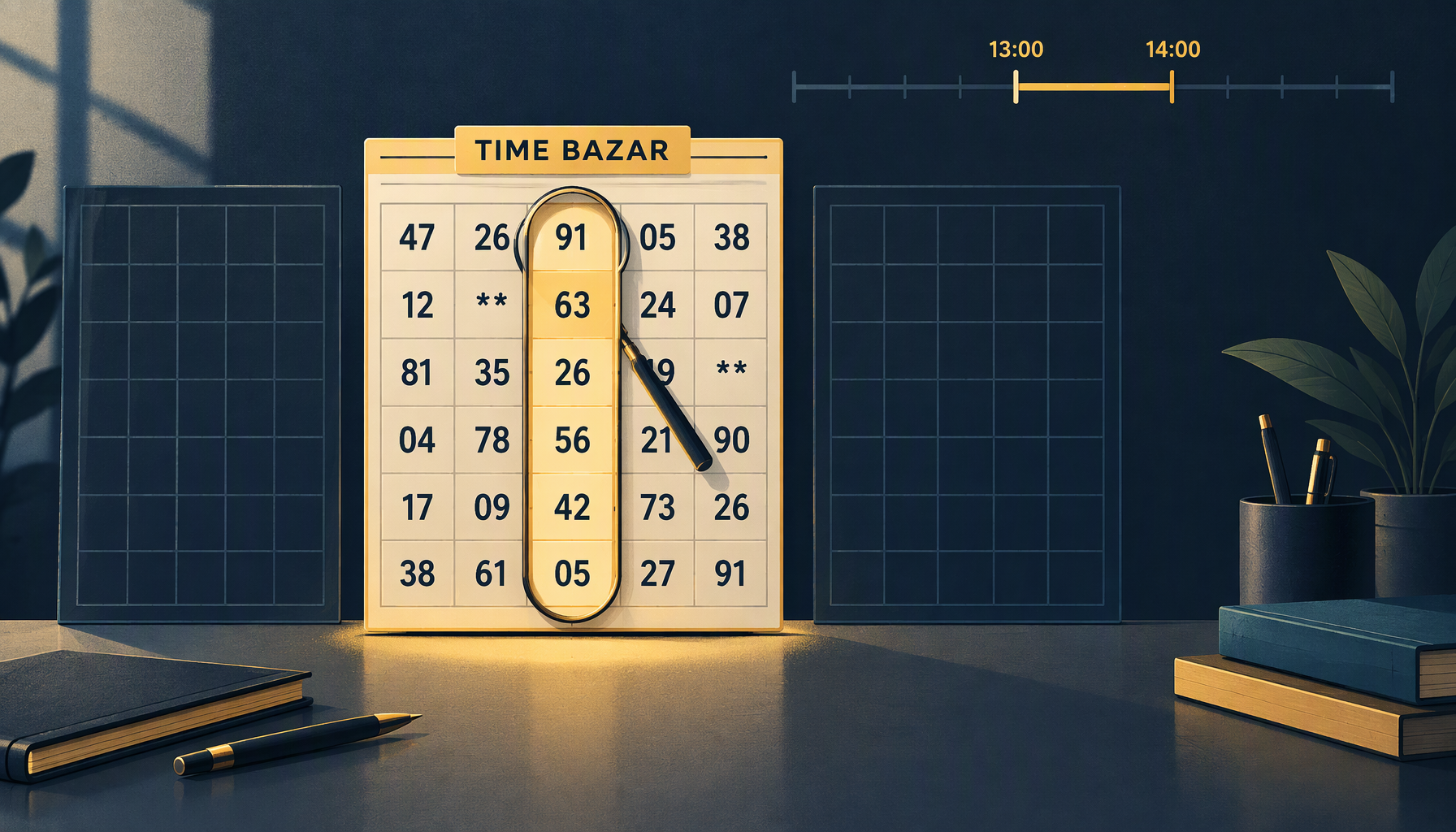
Time Bazar is a one-hour market on a board that runs mostly in two-hour blocks, and almost every mistake made reading its chart comes from that mismatch. Its window is 13:00–14:00 IST: the open session closes at 13:00, the close session at 14:00, and the entire daily record — open pana, open Ank, close pana, close Ank, and the jodi built from the two — exists or does not exist inside those sixty minutes. That is narrower than most readers expect, and it is not the same thing as being a morning market, which Time Bazar is not. This guide covers what the chart actually shows, how to read it against the schedule, and where "predicting patterns" stops being a claim you can support.
The three facts to hold onto. Time Bazar runs 13:00–14:00 IST and is the third market of the day to finish, not the first. Its chart address is /chart/jodi/time-bazar with one a — the double-A spelling is a dead link, not a variant. And its close declares at 14:00 in the same minute as a structurally different market, so "the 2 o'clock result" is not a complete sentence.
Where Time Bazar Sits in the Day
The schedule is the first thing to get right, because the market's name invites the wrong answer. "Time Bazar" is a proper name, not a description of when it runs; the platform's own glossary treats Bazar as meaning no more than "market". On this board Time Bazar opens at 13:00 and closes at 14:00 IST — early afternoon, well after the actual morning rows.
Order the running markets by open time and the shape of the day becomes obvious. Time Bazar is the third market to finalise its day, and the whole afternoon block around it is thin:
| Clock (IST) | What the board is doing | MAIN markets running |
|---|---|---|
| 12:35 | Sridevi closes. No MAIN market is running at all. | 0 |
| 13:00 | Time Bazar opens. It is the only MAIN market live. | 1 — Time Bazar only |
| 13:15 | Parel Day opens. | 2 |
| 13:30 | Madhur Day opens; the block is at its peak. | 3 |
| 14:00 | Time Bazar closes and Dadar Day opens in the same minute. | 3 — Time Bazar no longer among them |
| 14:30 | The block unwinds; only the market that opened at 14:00 is left. | 1 — Dadar Day only |
Two things follow from that table, and they are the reason Time Bazar reads differently from the evening markets. First, for fifteen minutes — 13:00 to 13:15 — Time Bazar is the only MAIN market in session, immediately after a 25-minute stretch in which no MAIN market is running at all. A reader arriving in that window has exactly one live main chart to look at. Second, its whole open-to-close span is 60 minutes, so the state where a day's jodi is still unknown lasts half as long as it does on the two-hour rows.
One Hour Is a Class, Not a Distinction
It is worth killing the most common overstatement before building on it. A short session is not unusual on this board; it is a quarter of it. Grouping all 25 MAIN markets by the distance between their open and close boundaries:
| Open to close | Markets | Count |
|---|---|---|
| 55 minutes | Gali | 1 |
| 60 minutes | Sridevi, Time Bazar, Madhur Day, Parel Day, Sridevi Night, Parel Night | 6 |
| 120 minutes | Milan Day, Rajdhani Day, Supreme Day, Kalyan, Dadar Day, Disawar, Faridabad, Ghaziabad and nine two-hour night rows | 17 |
| 135 minutes | Main Bazar | 1 |
So Time Bazar is not the shortest-session market on the board — Gali's 55 minutes is — and it is one of six that run the same one-hour shape. What is genuinely distinctive is not the length but the position: of the six one-hour rows, Time Bazar is the only one that sits alone in an otherwise empty stretch of the day. The practical consequence for reading is that its chart is the only one being filled in during that quarter hour, which is exactly when the most people check it.
Reading the Time Bazar Chart
A Time Bazar day is six digits and two timestamps, and everything on the page is derived from them. The full record reads as openPana – jodi – closePana, for example 149-47-269: the open pana's Ank is 4 (1+4+9 = 14 → 4), the close pana's is 7, and the jodi is those two digits in that order. The mechanics of that arithmetic are set out in the step-by-step results-reading walkthrough; what matters here is the order in which the pieces become available.
Because the two sessions are an hour apart rather than two, the intermediate state on a Time Bazar chart is real but brief. Until the close Ank exists there is no jodi to print — the cell is gated on the open digit, and a day that has one session but not the other renders a partial or empty pair rather than a number. On a two-hour market that partial state is the normal mid-session view; on Time Bazar it is a window you may miss entirely. The fill-in behaviour of both chart types, and which placeholder states are temporary, is worked through in the jodi versus pana comparison.
The reading order that costs the least time on a one-hour market is:
- Before 13:00 — nothing new. Any "Time Bazar result" quoted before the open boundary is either yesterday's or another market's.
- 13:00 to 14:00 — the open pana and open Ank may be present while the jodi cell is still not a number. This is the only hour in which Time Bazar can legitimately look incomplete.
- After 14:00 — the day is finished as far as the schedule is concerned. A cell still showing placeholders after that is a declaration question, not a timing question.
The URL Is Not Spelling-Insensitive
This is the single most common reason a reader ends up on the wrong page or no page, and it behaves inconsistently enough to be worth stating precisely. The chart address is /chart/jodi/time-bazar — one a, matching the market's stored name, which is also the spelling the glossary uses. The routing layer normalises the address it is given before it looks for a match, so capitalisation, spaces and underscores all survive: /chart/jodi/TIME-BAZAR, time_bazar and time bazar each resolve to the same market and are permanently redirected to the canonical lowercase form.
What does not survive is a different spelling of the word itself. Bazaar with a double a is an ordinary alternative rendering of the same name — readers are told to treat the two as one market — but normalisation only folds case and punctuation, not letters. So:
| Address | Result | Why |
|---|---|---|
/chart/jodi/time-bazar |
200 — the chart | Matches the stored name exactly. |
/chart/jodi/TIME-BAZAR |
301 → the canonical address | Case is folded before matching. |
/chart/jodi/time_bazar |
301 → the canonical address | Punctuation is folded before matching. |
/chart/jodi/time-bazaar |
404 — "Market not found" | Letters are never folded. To the router this is a different name. |
The asymmetry is deliberate in engineering terms and accidental in human terms: the system will correct your typing style but not your spelling. Bookmark the single-A form, and if a link was handed to you in a chat, check the number of A's before concluding the chart is missing.
Two Markets Declare at 14:00
Time Bazar's close boundary is not private. It shares the 13:00–14:00 window exactly with Rajdhani Starline, so both declare at 14:00 and both charts update in the same minute — and the two are not the same kind of market. A Starline row runs a panna-family game with no jodi and no sangam at all, which means the page at /chart/jodi/rajdhani-starline exists, is reachable, and has no jodi history to show. That overlap, and what it does to a jodi page for a market that has no jodi, is covered in the Rajdhani day and night analysis.
For a Time Bazar reader the consequence is narrower but practical: a result quoted as "the 2 o'clock number" is ambiguous, and it is ambiguous in a way the evening ones are not, because the two candidates have different structures rather than the same structure at different times. Quote the market name and the date, never the hour. Across the whole day there are only six minutes carrying more than one declaration, and this is one of them.
What "Predicting Patterns" Can Mean Here
The honest version of pattern work on Time Bazar is bounded by three numbers, none of which is a pattern.
- One jodi per running day. Time Bazar is a single market row with a single daily record — it does not have a day and a night sibling to pool with, so a year of faithful declarations is on the order of 365 observations, not 730. Any statement about "how this market behaves" is a statement about at most that many draws.
- A base rate that is already known. A specific jodi appears about 1 time in 100 draws, and the counts you should expect to see in any realistic sample — including the streaks and the absences that look meaningful — are worked out in the weekly chart analysis guide. That arithmetic is the same for Time Bazar as for every other market, because the draw does not know what hour it is.
- A denominator that is declarations, not days. A date with no declared digit is absent from the archive rather than recorded as blank, and a weekday switched off for this row simply produces nothing. The mechanism is in the Milan day and night analysis.
Put together, that leaves a workable definition of prediction for this market: not forecasting the next jodi, but deciding in advance what you will do at 13:00 and at 14:00, on which days, with how much, and against what number you will judge it after 100 declarations rather than after 10. A pattern that survives a written base rate and a written sample size is worth acting on. One that only survives being looked at in a chart is a shape, not a finding — and Time Bazar's short, quiet slot is exactly the kind of place where a reader has time to notice shapes.
A Pre-13:00 Checklist
Everything above compresses into six lines worth keeping beside the chart:
- Confirm the window. 13:00 open, 14:00 close, IST. If your clock is not IST, convert before deciding a result is late.
- Confirm the address.
time-bazar, one A. A double-A link 404s and looks like a missing chart. - Confirm the row. Time Bazar, not Rajdhani Starline, which closes in the same minute and has no jodi.
- Record the date, not the hour. Two markets declare at 14:00; one date plus one name does not.
- Note what you expected before 14:00. The open Ank is the only part of the jodi available inside the hour; anything claimed about the pair before the close is not a reading of the chart.
- Count declarations, not days. Write down how many dated rows you actually used when you describe a pattern.
Frequently Asked Questions
What time does Time Bazar declare?
The open session boundary is 13:00 IST and the close session boundary is 14:00 IST. Both results are normally out within that hour, which is why a Time Bazar day is settled by mid-afternoon while most of the board is still running.
Is Time Bazar a morning market?
No. Its name is a proper name, not a schedule description. On this board the genuine morning rows are Disawar (05:00–07:00), the Starline block (10:00–13:00) and Sridevi (11:35–12:35). Time Bazar runs at 13:00–14:00, which is early afternoon.
Why does my Time Bazar chart link not open?
Check the spelling first. time-bazaar with two A's is refused outright, while capitalisation and punctuation are handled automatically. If the address is right and the cells are empty, the underlying rows simply have not been declared for those dates.
How many results does Time Bazar produce in a year?
At most about one per day — roughly 365 dated records — because it is a single market row with one open and one close per day, and only if every running day is declared. Missing declarations and switched-off weekdays reduce that figure; nothing increases it.
Can I predict the next Time Bazar jodi from the chart?
Not in any sense that survives checking. Each draw is independent, so the chart's value is that it tells you what has already been declared and lets you compare your expectations against a known base rate — not that it carries information about the next number.
What is the difference between the Time Bazar jodi chart and its pana chart?
Same archive, different density. The jodi chart shows the two-digit pair per day and is quick to scan; the pana chart shows the full three-digit open and close panas, which is what you need to work out Ank, patti type and any sum. The two views are compared in the jodi versus pana guide linked above.
Does Time Bazar share its slot with another market?
Yes — Rajdhani Starline runs the identical 13:00–14:00 window, so both declare at 14:00. They are different kinds of market, and only Time Bazar has a jodi.
When is the Time Bazar chart for today complete?
The schedule says after 14:00 IST. A cell that is still showing placeholders later than that is a declaration or recording question, and the placeholder guide lists which of those states are temporary and which are permanent.