

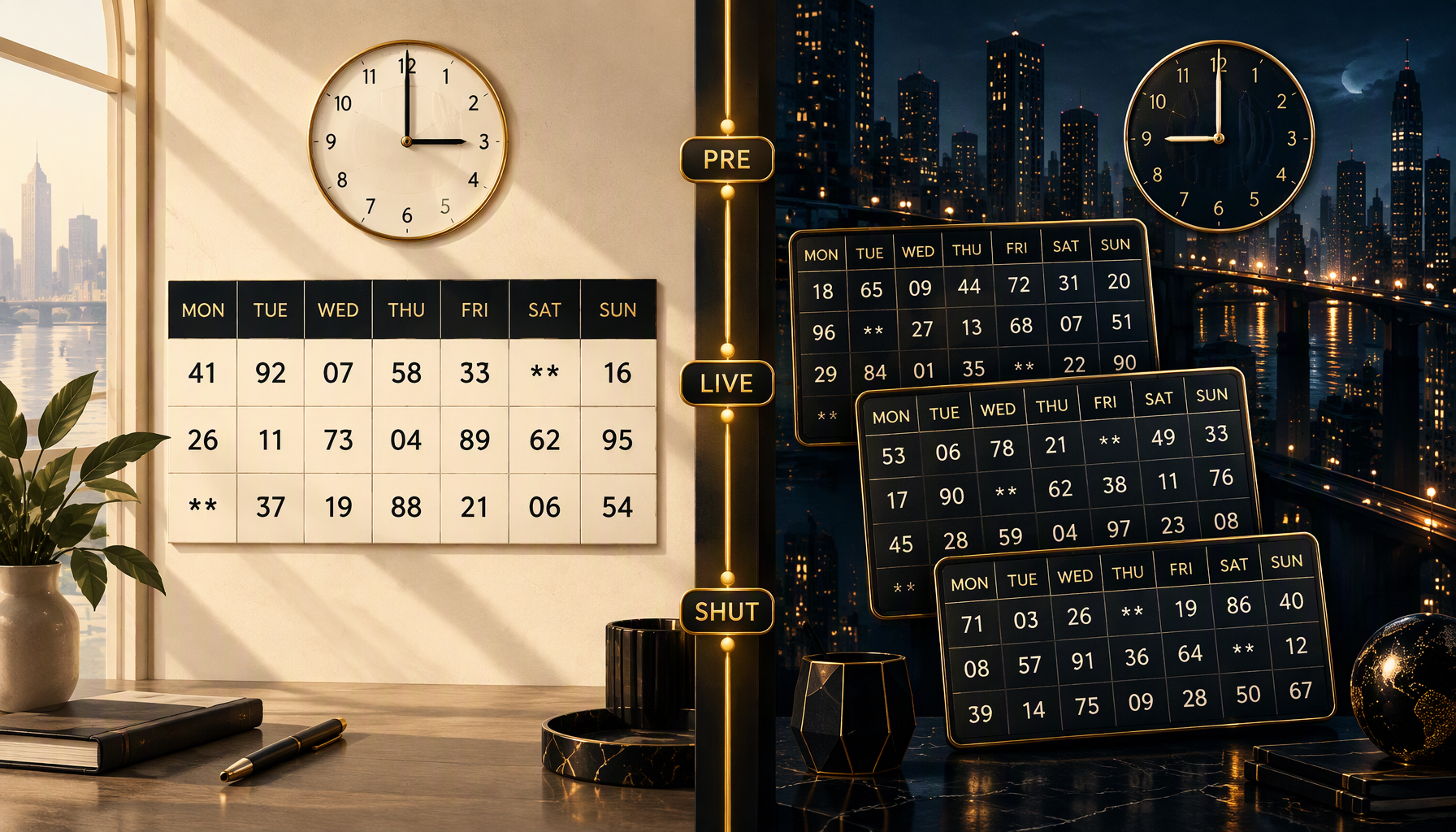
There is no single Milan chart to build a strategy on. "Milan" is three separate market records — Milan Day (open 15:00, close 17:00 IST), Milan Night (21:00 and 23:00) and Milan Starline (12:00 and 13:00) — each with its own archive, its own weekly grid and its own one-declaration-per-day sample. What a Milan strategy can honestly contain is therefore not a forecasting rule but a timing and record-keeping discipline: know which row you are reading, know the three states of that row's session clock, know that pooling Day and Night invalidates any count you take, and know that a blank column is a configured closure rather than a mystery.
Strategy here means a written decision process, not forecast power. Nothing in this guide changes the odds attached to a Milan result. What it changes is which record you are looking at, when a bet can still be accepted, and how likely you are to make an avoidable bookkeeping error — which, in a game whose numbers are fixed, is the only variable genuinely under your control.
Milan Is Three Markets, Not One
The schedule the platform runs on defines these as three independent rows, and the difference is not cosmetic: two are Main markets with an open and a close session, and one is a Starline market with a completely different result structure.
| Market row | Type | Open (IST) | Close (IST) | What the record carries |
|---|---|---|---|---|
| Milan Day | MAIN | 15:00 | 17:00 | Open pana and close pana, and the jodi formed from their two Ank digits. |
| Milan Night | MAIN | 21:00 | 23:00 | Same two-session structure, on a separate archive. |
| Milan Starline | STARLINE | 12:00 | 13:00 | Panna-family results only. The Starline model has no jodi and no sangam market at all. |
Because each row is its own market, each gets its own dated record: a market-day entry exists per market and date, so Milan Day's Tuesday and Milan Night's Tuesday are two different rows with two different results. The chart pages resolve one market at a time, which means the sentence "the Milan chart" is incomplete until you name the row — and any claim built by adding the two MAIN rows together has quietly doubled its sample while mixing two schedules. One row produces at most one declaration per day, so a Milan MAIN row yields roughly 365 observations a year, not 730.
Two of these rows also share their exact window with other markets, which is a naming hazard rather than a pattern: Milan Day and Rajdhani Day both run 15:00–17:00, and Milan Night, Dadar Night and Kuber all run 21:00–23:00. Three markets therefore declare a close result in the same minute at 23:00. If your notes say "94 at 11pm", they do not identify a market; if they say "Milan Night", they do.
The Session Clock: Three States, and the Result Beats the Clock
Every Main market's day is divided by exactly two boundaries, and the platform evaluates them as three named states rather than as a single open/closed switch. For Milan Day the boundaries are 15:00 and 17:00; for Milan Night they are 21:00 and 23:00.
| State | Milan Day window | What can still be bet |
|---|---|---|
PRE_OPEN |
Before 15:00 | Both the open-session bet and the close-session bet. |
OPEN_SESSION_CLOSED |
15:00 to 17:00 | The close-session bet only. The name refers to the open session being closed, not the market. |
MARKET_CLOSED |
After 17:00 | Nothing. |
Two refinements matter more than the table. First, the declared result overrides the clock: the bet-acceptance check looks at the result before it looks at the time, so once a session's result is published that leg is closed even if the scheduled minute has not arrived — and a jodi bet, which is stored against the close leg, is rejected the moment the close result exists. Second, there is a third gate ahead of both of these: a weekday check that rejects with a distinct reason when the market is not configured to run that day at all. The full set of limits — stake minimums, session locks and what happens to a bet that arrives late — belongs to the rules guide for new players; the point here is only that Milan Day gives you one clean morning-length window to decide, and Milan Night gives you the same window in the middle of the busiest part of the schedule.
If you want to follow a live session rather than an archive, the status badges and the partial-result states are covered step by step in how to read Satta Matka results.
Why the Day Row and the Night Row Are Different Problems
The two MAIN rows have identical structure — two hours, two sessions, one declaration each — so the honest differences are all about context. The clearest one is schedule density, which you can read straight off the seeded times.
- At 15:00, when Milan Day opens, only three Main rows are live anywhere: Milan Day, Rajdhani Day and Dadar Day.
- At 21:00, when Milan Night opens, eight Main rows are live.
- At 21:35 that reaches ten, and nine are still running at 22:00.
- At 23:00, Milan Night's close minute, three markets declare at once, and four more follow between 23:20 and 23:55.
Nothing about the numbers changes between the two rows; your error rate does. The day row sits in a quiet block where a result is easy to attribute. The night row sits inside the densest 90 minutes of the whole schedule, where several results land within minutes of each other and at least one pair lands in the same minute. Anyone who has ever written down the wrong jodi and then "found a pattern" in it should treat that as the actual risk being managed. This is an attention and bookkeeping argument, not a claim about hot hours — a time of day has no influence on a draw.
What a Milan Chart Can Support, and What It Cannot
Frequency analysis on a Milan grid follows exactly the same arithmetic as any other Main market, and the full treatment — how the weekly grid is assembled, the base rates each outcome is measured against, and why hot and cold numbers are guaranteed before you look — lives in the Kalyan chart analysis guide. Read that before running your own counts. What is Milan-specific is the sample size and the temptation to inflate it.
One MAIN row produces at most one declaration a day. Over a full year that is about 365 observations, against which a single named jodi is expected roughly three to four times — a count so small that the difference between "hot" and "ordinary" is one or two appearances. That is the arithmetic reason a per-market "strategy" built on one year of a single row cannot be evidence of anything, and why pooling Milan Day and Milan Night to make the sample look bigger is worse than useless: it hides which row produced the number.
What the two rows can legitimately be compared on is structure, not luck. Comparing their windows, their weekday closures, their gap patterns or how many of their dated cells are actually filled is fair and useful. Concluding that "Milan Night behaves differently" because its jodi distribution looked unusual is the same noise question as anywhere else, asked with less data. If you are deciding which of the two grids to keep open on screen at all, the Jodi versus Pana chart comparison covers which view answers which question.
The Mechanism Behind an Empty Milan Column
Gaps in a weekly grid are not random, and for a Milan row there is a single mechanism producing them. Markets carry a per-weekday configuration: one row per market per weekday, holding an open or closed flag. The rule is deliberately asymmetric — the absence of a setting means the market is open, and only an explicit closed entry stops it. There is no separate holiday calendar anywhere in the schema; that weekday table is the whole story.
Two consequences for Milan specifically. Because the setting is attached to a market row, closing Milan Day for a weekday does not close Milan Night for the same weekday — the two rows are configured independently, so "Milan is off on Tuesdays" may be half true and you should check both grids. And because the flag covers a whole day rather than a single leg, the weekday check sits ahead of every other gate in the bet path, so on a closed day both legs are refused together with the same distinct reason — you will never see a half-filled day produced by this mechanism. When you count anything, this is the reason to count filled cells rather than rows.
No Midnight Rollover to Allow For
Market timing has one genuinely subtle edge case, and Milan is not part of it. The session-state logic natively supports overnight markets — a window whose open time falls after its close time, where a post-midnight session must be attributed to the previous calendar date, which the platform handles through a logical market date rather than the raw system date.
In the current schedule, however, none of the 31 seeded market rows has an open time at or after its close time, so that rollover branch never fires. Both Milan MAIN rows sit entirely inside one calendar day, and Milan Night's 23:00 boundary is its last. Practically: for Milan, the calendar date and the market date always agree, and a result you see at 23:05 belongs to the same day's row. Treat this as a fact about today's schedule rather than a permanent property — market times are configuration, and configuration changes. The terms themselves, including logical market date and session lock, are defined in the terminology glossary.
A Milan Decision Sheet
If "Milan strategy" is going to mean anything, it has to be written down before the session rather than discovered during it. The minimum viable version is the same short sheet for both rows.
| Field | Milan Day | Milan Night |
|---|---|---|
| Row named in your notes | "Milan Day", never "the 5 o'clock one" | "Milan Night", never "the 11 o'clock one" |
| Decide-before deadline | 15:00 — the open leg closes at this boundary | 21:00 — same rule, inside a crowded block |
| Hard stop | 17:00 | 23:00 |
| Sample you will actually use | This row's filled cells only | This row's filled cells only, never pooled with Day |
| Review window | Fixed before counting; complete weeks only | Fixed before counting; complete weeks only |
| Written stop condition | Required — and it must be about your process, not the numbers | Required — same |
The last row is the one people skip. A stop condition tied to behaviour ("I re-windowed twice, so the count is void") is testable and within your control. A stop condition tied to results ("when the streak breaks") is not either thing.
Four Milan Mistakes Worth Naming
Treating the two MAIN rows as one market
It doubles your apparent sample, mixes two schedules and makes every percentage you quote untraceable to a record. Name the row in the note, every time.
Reading OPEN_SESSION_CLOSED as "the market is closed"
It means the open leg has passed its boundary while the close leg is still live. Between 15:00 and 17:00 Milan Day is very much still open for business — on one side only.
Assuming an empty column is a data fault
Absence of a weekday setting means open, so a blank is an explicit closure or a date outside the archive. Both are ordinary, and neither is a bug to chase.
Deciding the night row is "more active"
It sits in a denser part of the schedule, which changes your workload and your error rate, not its outcomes. Activity is a property of the calendar, not of the draw.
Frequently Asked Questions
Is there a Milan Day chart and a separate Milan Night chart?
Yes — one per market row. Each grid is built from that row's dated records only, so the two never share cells, gaps or counts.
Can I use Milan Starline's results in a Milan jodi analysis?
No. The Starline structure has no jodi market at all, so there is nothing on that row to count in a jodi analysis.
Which Milan row has more data?
Structurally the same maximum: one declaration per running day. The row that has run on more weekdays wins, which is a scheduling fact you can read off the grid before you count anything.
Does the 23:00 close mean Milan Night results appear at 23:00?
The close boundary is 23:00; the declaration is a separate act by whoever publishes the result, and the published result — not the clock — is what closes the betting leg. A chart page can also lag a fresh declaration slightly because of caching.
Can a Milan row be closed for a single day?
The configuration is per weekday, not per date, so a closure repeats on that weekday until it is changed. A one-off gap is therefore more likely to be an undeclared or historic date than a scheduled closure.
What Milan Analysis Is Actually Worth Doing
Reduced to what the records support, a Milan practice is unglamorous and specific: keep the two MAIN rows apart in your notes and in your counts, know each row's two boundaries and the fact that a published result beats the clock, treat a blank weekday as a configuration you can verify rather than a signal, and hold any frequency claim to the base-rate discipline set out in the chart analysis guide. That is the whole defensible list. Everything beyond it — carrying a number from the day row into the night row, reading the 23:00 cluster as a hot hour, sizing a stake up because a jodi looks due — is a story told about an archive, and the safer-play guidance elsewhere on this blog exists precisely because those stories tend to end in money.