

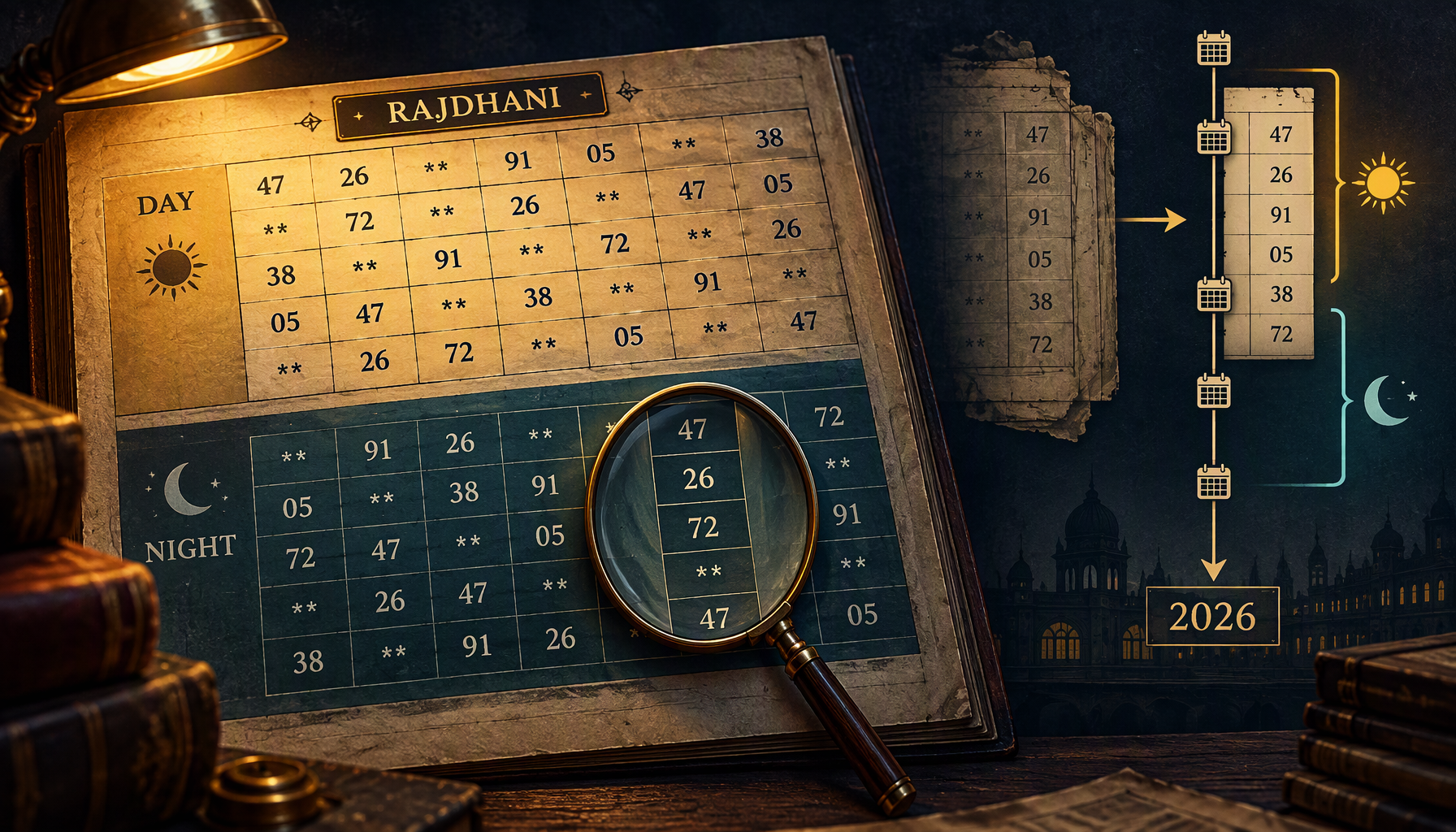
The ceiling on a Rajdhani historical analysis is set by how the archive is assembled, not by how carefully you read it. There are three market rows carrying the name — Rajdhani Day (15:00–17:00 IST), Rajdhani Night (21:35–23:35) and Rajdhani Starline (13:00–14:00, a panna-only game with no jodi at all) — and the two places you can pull history from cover different spans: the chart pages reach back three years, while the public results feed is built on a 730-day window. On top of that, the record contains declarations rather than days, and an ambiguous name such as plain "rajdhani" is refused by one surface and silently guessed at by the other. Any finding worth keeping has to survive all four of those facts.
The reproducibility rule. A historical claim about Rajdhani is only worth the metadata attached to it: which row, read from which surface, extracted on which date, over a cohort defined as what rather than a date span. Missing any one of the four, the number cannot be checked again — including by you.
Three Rajdhani Rows, and Only Two Share a Structure
The schedule carries the name three times, and they are three independent markets rather than three views of one.
| Market row | Type | Open (IST) | Close (IST) | History it can carry |
|---|---|---|---|---|
| Rajdhani Day | MAIN | 15:00 | 17:00 | Open and close panas plus the jodi formed from their Ank digits. |
| Rajdhani Night | MAIN | 21:35 | 23:35 | Same two-session structure on a separate archive. |
| Rajdhani Starline | STARLINE | 13:00 | 14:00 | Panna-family results only — the Starline model has no jodi and no sangam. |
Two details matter for anyone comparing Rajdhani against the rest of the board. First, the name is not a unique key on the clock: Rajdhani Day's 15:00–17:00 window is shared exactly with Milan Day, and Rajdhani Starline's 13:00–14:00 window is shared exactly with Time Bazar, a Main market with a completely different structure. Same minutes, different records — the overlap itself is worked through in the Milan Day and Night analysis. Second, the two Rajdhani MAIN rows never run at the same time: Day closes at 17:00 and Night opens at 21:35, a 275-minute gap, so there is no moment in the day when a "Rajdhani" result is ambiguous between them. That is convenient, and it is also the only sense in which the pair behaves like one thing.
Asking for Rajdhani History: The Page Refuses, the Feed Guesses
This is the fact that quietly invalidates the most extracted history, and the two surfaces disagree about it.
The chart route resolves a market strictly — an exact name, with hyphens normalised to spaces, or an exact slug of one. Ask it for the generic name and it stops you: /chart/jodi/rajdhani returns HTTP 404 with "Market not found: rajdhani" and a "Chart Not Available" page, while /chart/jodi/rajdhani-day and /chart/jodi/rajdhani-night each serve their own grid. You cannot get an accidental archive out of it.
The public results endpoint is built the other way round. It tries an exact name, and when that fails it falls back to a contains match and keeps the first row the database hands back — with no ordering requested. So /api/result/rajdhani answers HTTP 200 with success: true and a data array, having silently chosen one of the three Rajdhani rows. The response does carry the market's own name on every item, which is the only way to know what you were actually given. There is a second asymmetry: the feed does not do the hyphen-to-space normalisation the page does, so /api/result/rajdhani-night reports "Market not found" while the spaced form resolves.
For a historical analysis the consequences are direct. An empty data array from the feed is ambiguous — it can mean a row with no records in the window just as easily as a row you did not intend to ask for. And a feed-based count is only as good as the name you typed, because nothing in that path will tell you it guessed. Prefer the named chart page for anything you intend to keep, and if you use the feed, assert on the market name inside the payload rather than on the name you sent.
Two Windows, Two Different Histories
Both surfaces read from the same underlying query, and then they disagree about how far back to ask it.
| Surface | Window it requests | Approximate span | What it returns |
|---|---|---|---|
| Chart pages (jodi and pana grids) | Today back three years | Roughly 1,096 days, about 157 Monday-anchored week rows | Full per-day open pana, jodi and close pana laid out by weekday. |
| Public results feed | Today back 730 days | Roughly 104 weeks | Open and close panas per dated row. No jodi, no Ank digit. |
The practical reading: the page can show around a year of Rajdhani history that the feed will not return at all, and the feed cannot answer a jodi question however far back you push it. A claim that begins "I pulled the full history" has to name which of these two it came from, or it is not a defined quantity.
Both windows are also anchored to the current date rather than to a fixed start, which makes them sliding. Every day, the oldest week quietly leaves the page and the oldest entry leaves the feed. A count taken last month is therefore not reproducible from the same source today — not because the data changed, but because the window moved. This is the single easiest thing to get wrong in a longitudinal note and the easiest to protect against: write the extraction date beside the number. The grid mechanics behind all of this — how the week rows are built, why the newest one is incomplete, and how long a fresh declaration can take to appear — are covered in the weekly chart analysis guide.
The Archive Records Declarations, Not Days
A dated row reaches either surface only if at least one of its two sessions carries a declared digit. That one condition shapes everything a historical analysis can claim about Rajdhani.
- A day the market ran but nobody declared is absent, not blank. It is not in the archive as a zero, a gap or a placeholder — the query simply never returns it.
- A weekday closed by configuration produces nothing at all, and that configuration is held per market row, so Rajdhani Day and Rajdhani Night can have different sets of running days over the same calendar span. The mechanism is the weekday settings table explained in the Milan piece.
- Dates older than the records a platform carries are missing for the same reason the two above are. What the asterisk states mean, and which of them are permanent, is set out in the placeholder guide.
Put together, the denominator of any Rajdhani ratio is the dated rows present in the window for that row — not the number of days between two dates, and not seven times the number of weeks. Two people can honestly compute different frequencies for the same month while both being right, if one divided by calendar days and the other by declarations. State the cohort, and the disagreement disappears.
Why the Night Row's History Is Harder to Keep Straight
The two MAIN rows produce the same kind of record at the same rate — one declaration a day each — but they sit in wildly different parts of the schedule. Counting from the seeded times across the 25 Main rows:
- At 15:00, when Rajdhani Day opens, only three Main rows are live anywhere.
- At 21:35, when Rajdhani Night opens, ten are live, and eleven by 21:40.
- From 21:35 to the last close at 23:55 there are twelve declarations in 140 minutes — roughly one every twelve minutes — with three landing in the same minute at 23:00. Rajdhani Night's own close is 23:35, the second-to-last of the day.
Nothing about the draws differs between those two blocks. What differs is the transcription environment: the day row's result can be reconciled in a quiet minute, while the night row's arrives in a queue where several markets declare within minutes of each other and at least two share a minute. Most "the chart looks wrong" reports are born in that queue. Reconcile from the row's own chart page rather than from a screenshot, a forwarded list or a chat summary, and reconcile by date first — the workflow for that is in finding an older result by date.
A Historical Analysis Sheet for Rajdhani
Six fields, filled in before any number is written down, and the analysis becomes checkable by someone who was not there.
| Field | What to record |
|---|---|
| Row | Rajdhani Day, Rajdhani Night or Rajdhani Starline — never "Rajdhani". |
| Surface | Chart page or results feed, and note that only the page carries jodi. |
| Extraction date | The day you pulled it, because both windows slide daily. |
| Window | First and last dated row actually present, not the requested span. |
| Denominator | Count of declarations used. State it next to every frequency. |
| Censoring | Whether the newest, still-incomplete week was included. It should not be. |
What Rajdhani History Can Settle — and What It Cannot
It can settle: which dates have records and which do not; how the two MAIN rows differ in coverage; how a specific date's result was declared; how often an outcome appeared across a stated denominator, judged against the base rates and variation bands set out in the chart analysis guide; and whether a number you remember is actually on the record.
It cannot settle: anything about the next declaration; whether the night row "behaves differently" from the day row, which is a frequency question asked on roughly 365 observations a year; what a pooled Day-plus-Night count means, which is nothing in particular; or why a gap exists, which requires the configuration and placeholder facts above rather than an inference from absence. The terms the sheet leans on — logical market date, session lock, declaration — are defined once in the terminology glossary.
Four Mistakes Specific to Historical Reads
Pooling the two MAIN rows into one "Rajdhani" series
It doubles the apparent sample, mixes two schedules and two configurations, and destroys the only thing a history has going for it: that each row can be traced to a dated record.
Trusting a feed response without reading the market name inside it
The feed will resolve an ambiguous prefix to whichever row it encounters first and report success. The payload names the market it actually used; check it.
Comparing a page count with a feed count
Three years against 730 days, full jodi detail against panas only. The difference between the two numbers is the difference between the sources, not a finding.
Reading a missing date as a zero
Undeclared, closed and out-of-range dates all vanish from the query rather than appearing as blanks. Absence of a row is not an observation about that day's result.
Frequently Asked Questions
How far back does Rajdhani chart history go on this site?
The chart pages request three years from today; the public results feed requests 730 days. Neither is a fixed archive — both start points move every day, so record the date you looked.
Why does the URL for "rajdhani" fail when "rajdhani-day" works?
Because the page requires an exact market name or slug, and there is no market called simply Rajdhani — there are three. That refusal is the helpful behaviour; the feed's equivalent is to pick one silently.
Can I get Rajdhani jodi history from the results feed?
No. The feed returns the open and close panas per dated row. The jodi is on the chart pages, which is where a jodi history has to be taken from.
A date is missing from both Rajdhani grids. Does that mean the market did not run?
Not necessarily. A missing row means no declaration was returned for it, which covers a configured weekday closure, an undeclared day, and a date outside the retained archive. The row's own configuration decides which, and the two MAIN rows are configured separately.
Is a two-year feed count comparable with a three-year page count?
Only after you re-cut both to the same span and the same denominator. Comparing them as they came out measures the sources, not the markets.
The Honest Scope of a Rajdhani Archive
Done properly, a historical analysis of these charts is mostly bookkeeping: name the row, name the surface, date the extraction, define the denominator, and leave the incomplete week out. It is unglamorous work, and it is the only part of the exercise that is genuinely within your control — the numbers themselves are as unreadable in advance as they have ever been, however much history you line up behind them.